23 March 2026 – Singapore has broken several rainfall and temperature records in 2025, according to the Meteorological Service Singapore’s (MSS) 2025 Annual Climate Assessment Report [1], which covers the year’s climate conditions and notable weather events. This report has been published in conjunction with World Meteorological Day and features the latest coverage of Singapore’s heat stress monitoring network, in line with the theme “Observing Today, Protecting Tomorrow”.
Singapore’s 2025 Climate Overview
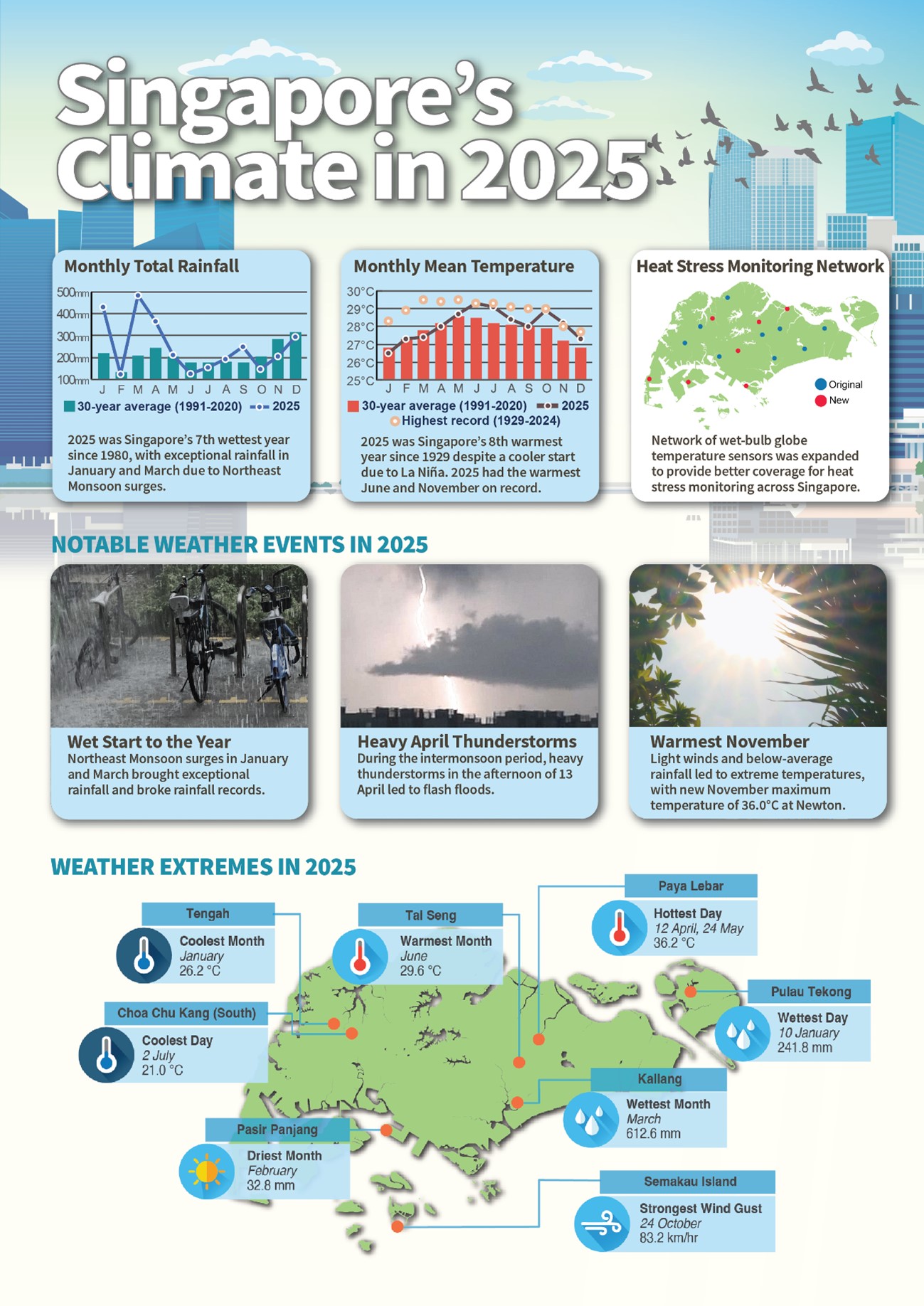
2. 2025 began with wet and cool weather from January to March due to La Niña [2] conditions and Northeast Monsoon surges, which brought Singapore its wettest March on record. The above-average rainfall in the early months made 2025 Singapore’s 7th wettest year since 1980. However, the weather pattern shifted from May onwards, with Singapore experiencing its warmest June and November on record. Despite La Niña’s cooling influence, 2025 still ranked among Singapore’s top 10 warmest years.
Temperature
3. Singapore’s average temperature [3] in 2025 was 28.1 degrees Celsius, making it the joint 8th warmest year on record alongside 2010 and 2002, despite La Niña conditions. This reflects the influence of the ongoing long-term warming trend globally and Singapore. Singapore’s annual mean temperature has risen by 0.24 degrees Celsius per decade since 1984.
4. Several temperature records were matched or broken in 2025. June 2025 was Singapore’s warmest June since 1929, tied with 1997. November saw multiple temperature records broken, including the highest-ever November temperature of 36.0 degrees Celsius recorded at Newton on 1 November during an exceptionally warm and dry period. November was also Singapore’s warmest November since 1929.
Heat Stress
5. Singapore recorded its highest heat stress reading ever when the Wet Bulb Globe Temperature (WBGT) reached 35.0 degrees Celsius at Palawan Green (Sentosa) on 31 October.
6. To enhance monitoring capabilities, MSS expanded its heat stress monitoring network by adding seven new stations in 2025 and a further five stations in January 2026, bringing the total to 20 operational stations across Singapore today. Singapore experienced 29 days of high heat stress [4] in 2025. September and October had the most such days for those months since 2018, partly due to improved detection from our expanded network.
Rainfall
7. 2025 was the 7th wettest year since 1980, with annual total rainfall [5] of 2984.9mm, 18 per cent above the long-term average. Three monsoon surges brought exceptionally wet conditions early in the year. March 2025 was the wettest March on record, with islandwide average rainfall of 482.9mm – 130 per cent above the month’s long-term average. The climate station’s monthly total rainfall of 550.1mm broke the previous March record of 528.3mm set in 1913.
8. Singapore’s rainfall is increasing, with annual total rainfall increasing by 92.5mm per decade from 1980 to 2025. Over the same period, Singapore experienced more rain on wet days [6], indicating heavier downpours when it rains. In 2025, the average rainfall on wet days was 13.8mm, the second highest on record, after 2021 (14.4 mm/day).
Notable Weather Events in 2025
Three Northeast Monsoon Surges in Early 2025
9. Early 2025 marked one of Singapore’s wettest starts of the year on record, with three monsoon surges. Two of these surges occurred in quick succession – the first from 10-13 January, the second from 17-19 January, and a third on 19-20 March. During the first surge, Pulau Tekong recorded 241.8mm of rainfall on 10 January, setting a record for the highest daily rainfall in January.
Record-Breaking Heat in November
10. The first half of November 2025 was exceptionally warm, with daytime temperatures exceeding 33 degrees Celsius and notably dry conditions across Singapore. On 1 November, Newton recorded 36.0 degrees Celsius, the highest temperature ever observed in November, surpassing the previous record of 35.8 degrees Celsius.
Heavy Thunderstorms in April
11. Heavy thunderstorms in April 2025 led to flash floods on a few days. In particular, intense thunderstorms on 13 April resulted in torrential rain, which peaked around 2pm. Yishun Ring Road area recorded 117.0mm of rainfall that day, the highest for April 2025. Flash floods occurred at Yishun, Punggol and the Kallang-Paya Lebar Expressway near Buangkok, but all subsided within an hour.
Strengthening Singapore’s Climate Resilience
12. Despite temporary cooling by La Niña in 2025, the warming trend continues both globally and in Singapore. Rising temperatures and related extreme weather events highlight the importance of climate adaptation. Singapore is strengthening its climate preparedness with Ministry of Sustainability and Environment (MSE)’s designation of 2026 as the Year of Climate Adaptation and the launch of the nation’s first National Adaptation Plan in 2027, reinforcing the government’s commitment to building a climate-resilient Singapore.
———
[1] The full report is available at www.weather.gov.sg. Please refer to Annex A for the infographic and Annex B for a summary of temperature and rainfall records matched or broken in 2025.
[2] La Niña is one phase of the El Niño-Southern Oscillation, a climate phenomenon in the tropical Pacific that affects climate around the world.
[3] Long-term temperature trends are based on records from the climate station, which began from 1929.
[4] Heat stress levels are based on Wet Bulb Globe Temperature (WBGT). Days of high heat stress are defined when any hourly average WBGT at a station is equal to or greater than 33 degrees Celsius.
[5] Singapore’s annual total rainfall is calculated from the average across 32 stations islandwide with continuous rainfall records starting from 1980.
[6] A day is considered a wet day when the daily rainfall averaged across islandwide stations ≥ 1 mm.
~~ End ~~
ANNEX A
ANNEX B
Table 1: Summary of record-matching and record-breaking (in bold) temperatures and rainfall at the climate station in 2025.
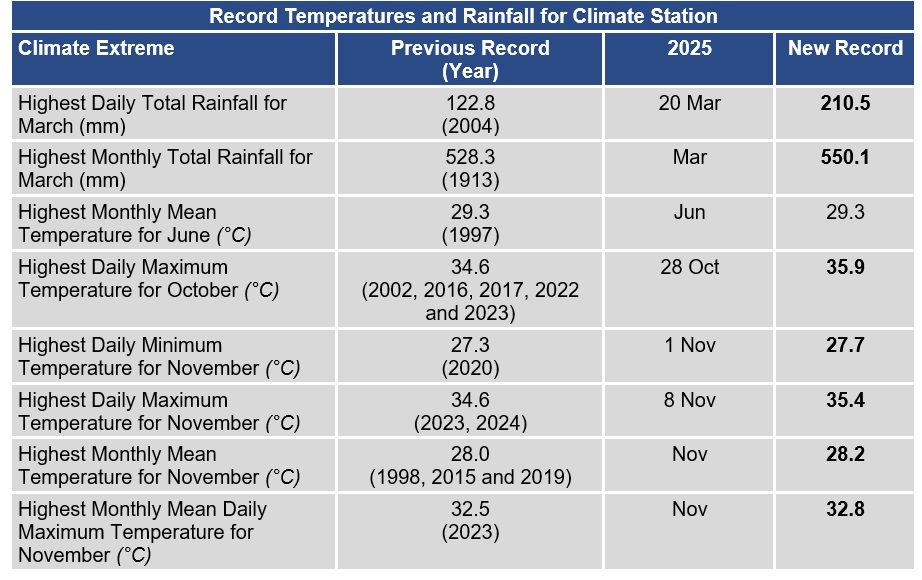
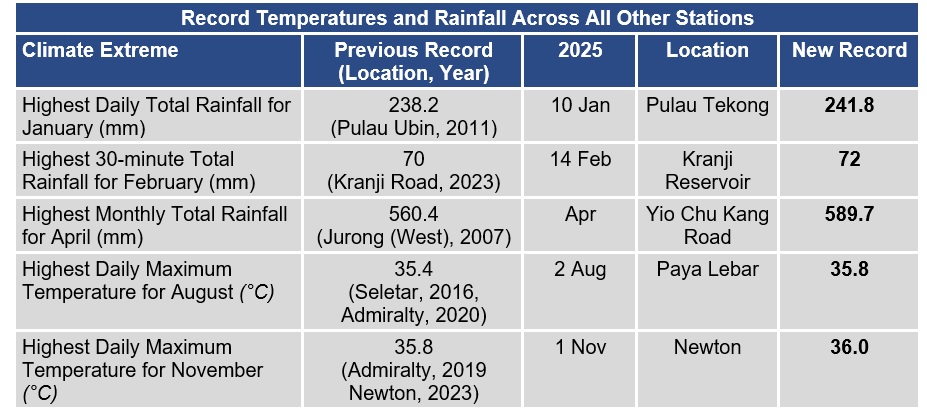
Table 2: Summary of record-matching and record-breaking (in bold) temperatures and rainfall across all other stations in 2025.