

EI Niño/La Niña Status
Updated on 18 September 2026
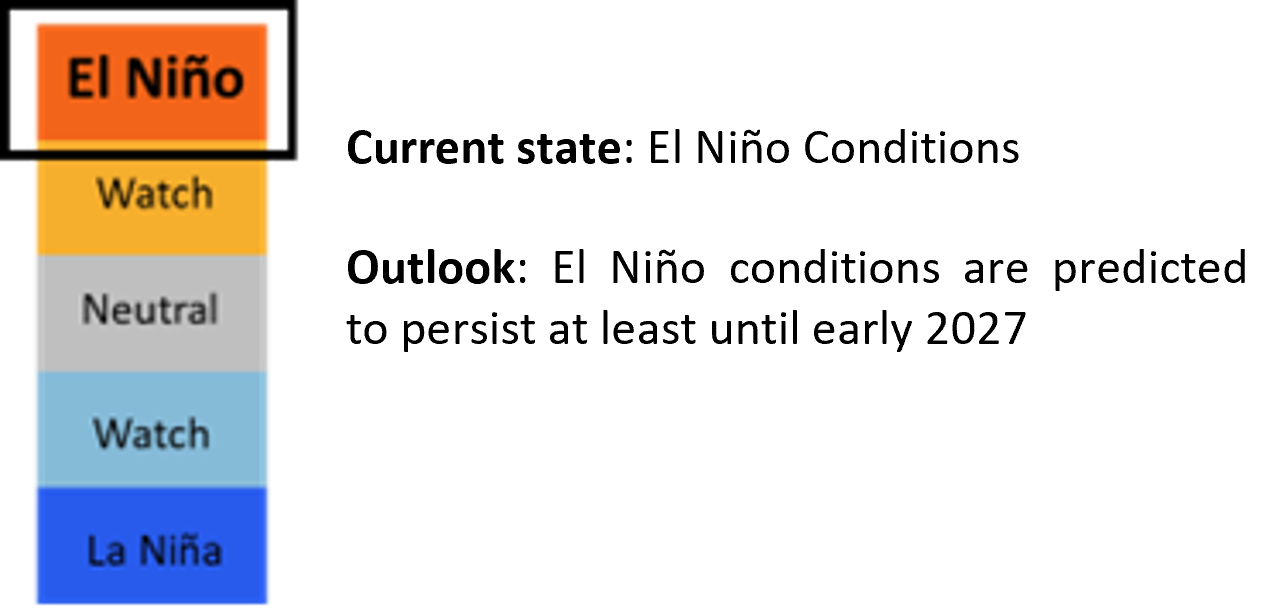
The El Niño – Southern Oscillation (ENSO) monitoring system state is “El Niño Conditions”. The Relative Nino3.4 index supports the presence of strong El Niño conditions in August 2026. Key atmospheric indicators (cloudiness and trade wind anomalies) are also consistent with well-established El Niño conditions.
The Nino3.4 index was 1.7°C for August 2026, and 1.3°C for the three-month average June – August 2026 based on the Relative Oceanic Nino Index.
El Niño conditions are expected to continue throughout the second half of 2026 into early 2027 and predicted to continue strengthening until October – November 2026.
Short note on the Indian Ocean Dipole: There were signs of a positive IOD developing in August 2026, although positive IOD conditions have yet to become established. Models predict a positive IOD in September – October 2026, followed by a weakening and a return to neutral by January 2027.
Further Information on ENSO
ENSO conditions are monitored by analysing Pacific sea surface temperatures (SSTs), low level winds, cloudiness (using outgoing longwave radiation), and subsurface temperatures. Special attention is given to SSTs, as they are one of the key indicators used to monitor ENSO. Here, three different datasets are used: HadISST1.1, ERSSTv5, and COBE2 datasets. The Relative Nino3.4 index is used, which compares the SSTs in the Nino3.4 region with the tropical average, accounting for long-term and other shifts in the climate.
El Niño (La Niña) conditions are associated with warmer (colder) SST anomalies in the central and eastern Pacific. The threshold for an El Niño (La Niña) in the Nino3.4 Region is above 0.6°C (below -0.6°C). El Niño (La Niña) conditions also correspond to an increase (decrease) in cloudiness around or to the east of the international dateline (180°), with a decrease (increase) in cloudiness in the west. There is also a decrease (increase) in the trade winds in the eastern Pacific. Sub-surface temperatures in the eastern Pacific should also be warmer (colder) than average, to sustain the El Niño (La Niña) conditions.
International climate centres use different criteria, including different SST thresholds, suitable for their own region and applications. Therefore, variations between centres on the current ENSO state should be expected, especially when conditions are borderline.
The relative sea surface temperatures (SSTs) in the tropical Pacific in August 2026 were above-average in the central and eastern portion of the region and below-average in the west (Figure 1). The warm (positive) anomalies in the Nino3.4 region (red box) are indicative of the El Niño conditions during August 2026. SSTs were below- average over the eastern equatorial Indian ocean and near-average over the western equatorial Indian ocean, with the Indian Ocean Dipole index close to the positive IOD threshold, although along with atmospheric indicators (not shown) a positive IOD has yet to be established.
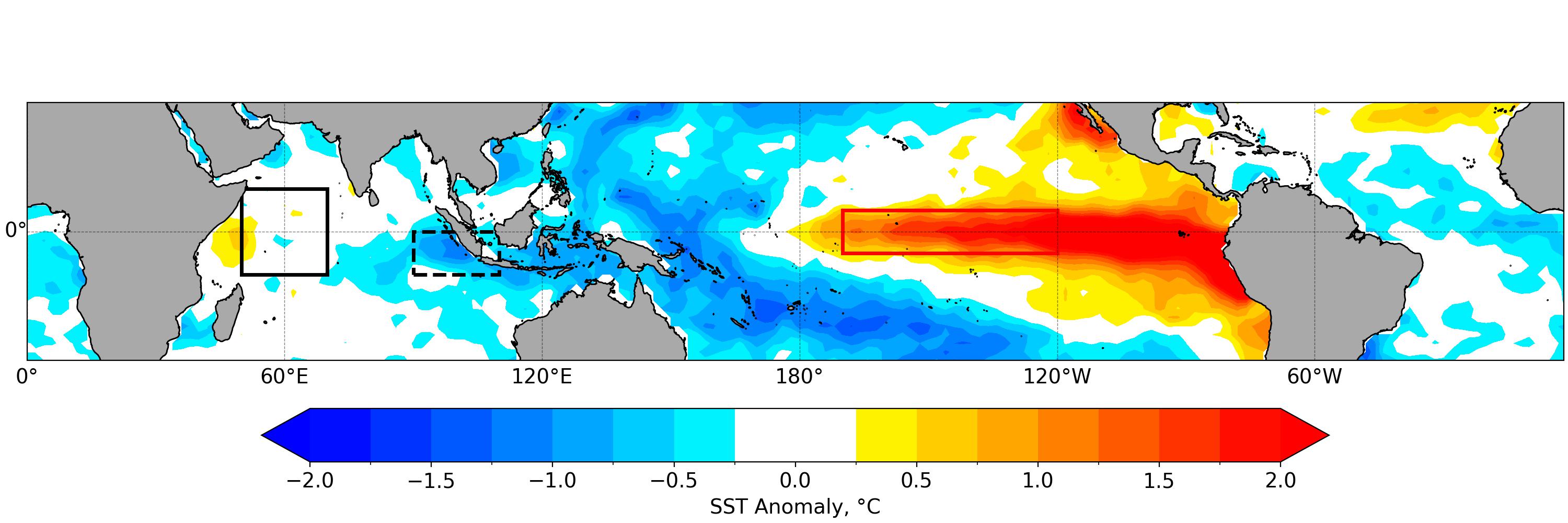
Figure 1: Relative SST anomalies (to the average tropical SST anomaly) for August 2026 using ERSST v5 data. Red (blue) shades show regions of relative warming (cooling). The tropical Pacific Ocean Nino3.4 Region is outlined in red. The Indian Ocean Dipole index is the difference between average SST anomalies over the western Indian Ocean (black solid box) and the eastern Indian Ocean (black dotted box).
Looking at the Relative Nino3.4 index in Figure 2, the 1-month Relative Nino3.4 index was negative, but within the neutral range, between March 2025 and August 2025. The index passed the La Niña threshold in September 2025 and returned to the neutral range in March 2026. Since then, the index has continued to warm. The May 2026 value was just below the El Niño threshold, with the June 2026 value passing the El Niño threshold and further warming in July and August. For El Niño conditions to be present, 1-month warm SST anomalies (observed or forecast) should persist for at least four months above the El Niño threshold, with at least one of the months observed; along with supporting atmospheric observations.
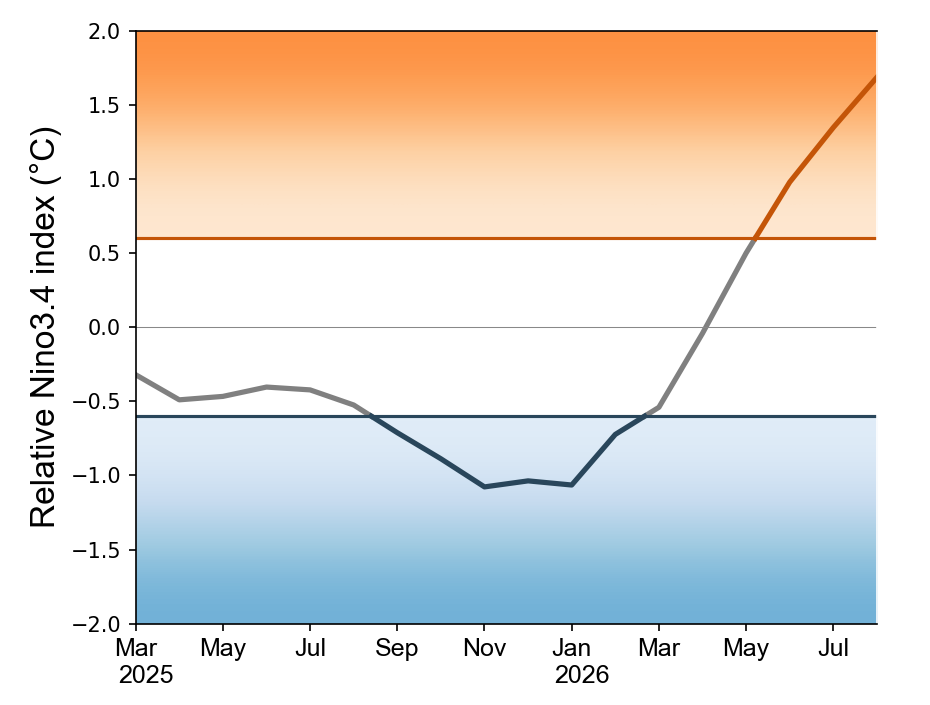
Figure 2: The Relative Nino3.4 index using the 1-month SST anomalies. Warm anomalies (≥ +0.6; brown4) correspond to El Niño conditions while cold anomalies (≤ -0.6; blue) correspond to La Niña conditions; otherwise neutral (> -0.6 and < +0.6; grey).
Model outlooks from Copernicus C3S (Figure 3), based on the Relative Nino3.4 SST index, predict the El Niño conditions to continue strengthening until October – November 2026. Most models predict the El Niño conditions to begin to weaken in December 2026 – January 2027, although to still be above the threshold for strong conditions (1.5°C) in early 2027.
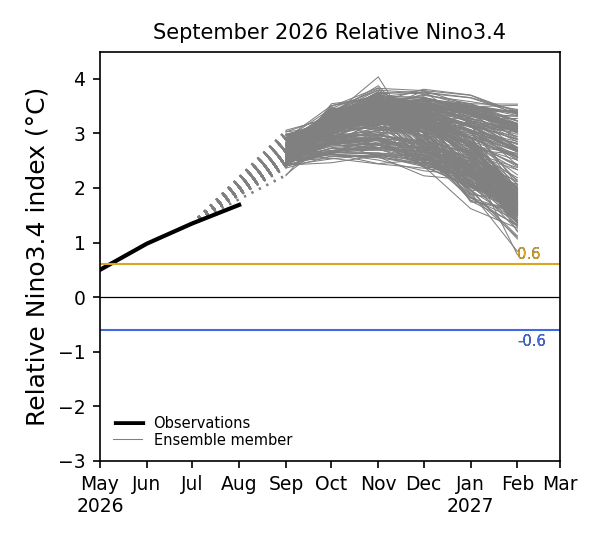
Figure 3: Forecasts of Relative Nino3.4 strength until February 2026 from various seasonal prediction models from international climate centres (grey lines). The solid blue and yellow lines note the La Niña and El Niño thresholds used by MSS.
Historical ENSO Variability
To classify a historical El Niño event, the Relative Oceanic Nino Index (RONI, or 3-month average Relative Nino3.4 value), must be above 0.6°C for 5 or more consecutive months. For La Niña events, the threshold is -0.6°C. Otherwise it is considered neutral. ENSO events with a peak value above 1.5°C (El Niño) or below -1.5°C (La Niña) are considered strong. Otherwise, the events are considered weak to moderate in strength. The following figure (Figure 4) shows the development the Relative Nino3.4 index for recent El Niño and La Niña events in comparison to other El Niño/La Niña events.
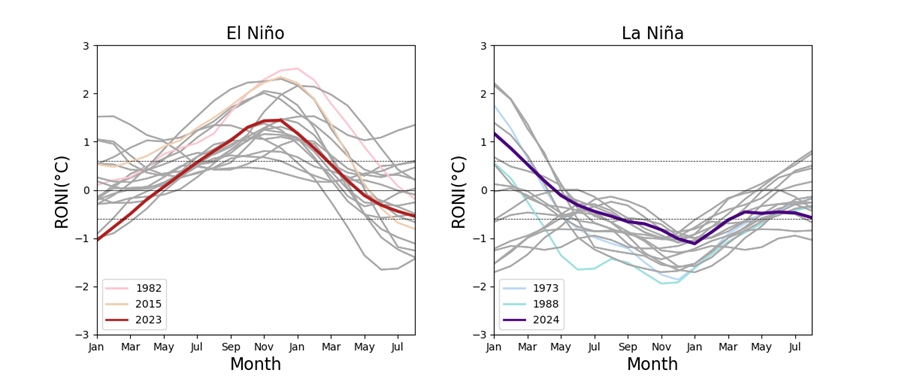
Figure 4: Relative Oceanic Nino Index (RONI) development and retreat of different El Niño (left)/La Niña (right) events since the 1960s. Recent El Niño and La Niña events are in red and purple, respectively.
Impact of El Niño/La Niña on Singapore
During the Southwest Monsoon months from June to September the correlation of ENSO with rainfall over Singapore is strong, (Figure 5), i.e. if El Niño or La Niña conditions are present, the rainfall patterns are likely to be influenced, particularly by a moderate or strong event (although there can still be considerable variability at the monthly timescale). When there are no El Niño or La Niña conditions present (i.e. ENSO-neutral), there is a large variability in rainfall (Figure 6).
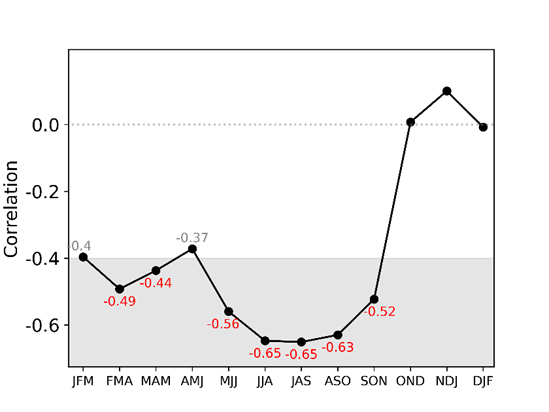
Figure 5: Correlation between total 3-month seasonal rainfall (averaged over Singapore stations) and seasonal Nino3.4 index from 1991-2025. The statistically significant correlations at the 95% level (±0.34) in grey, and at 99% level (±0.43) in red.
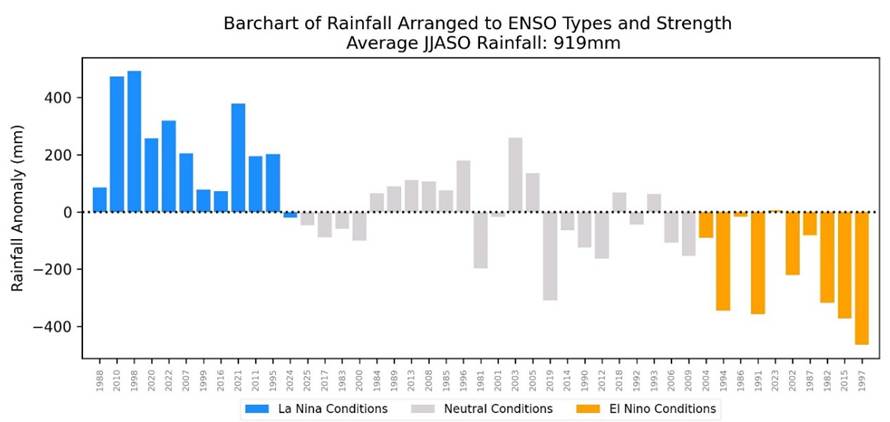
Figure 6: Singapore rainfall anomalies for June – October (as a departure from the 1991-2020 long-term rainfall average) arranged in the order from strong La Niña (left) to strong El Niño (right). Orange bars denote El Niño years’ anomalies, blue bars denote La Niña years’ anomalies, and grey bars denote ENSO neutral years’ anomalies.
References
Turkington, T., Timbal, B., & Rahmat, R. (2018). The impact of global warming on sea surface temperature based El Nino Southern Oscillation monitoring indices. International Journal of Climatology, 39(2).