Category Archives: Uncategorized

August 1, 2023

Warm Conditions with Short-Duration Thundery Showers Expected in the Coming Fortnight

Singapore, 1 August 2023 – The prevailing Southwest Monsoon conditions are expected to persist over Singapore and the surrounding region in the coming fortnight, with low-level winds continuing to blow from the southeast or southwest.

2     Localised short-duration thundery showers are forecast over parts of the island in the late morning and afternoon on some days during the first half of August 2023. On a few of these days, the thundery showers may be widespread and intense, when there is large-scale convergence of winds over Singapore and the surrounding region. Widespread thundery showers with gusty winds due to Sumatra squalls may occur between the pre-dawn hours and morning on one or two days. The presence of a dry air mass over Singapore and the surrounding region may bring relatively fair and warm weather to Singapore on a few days. Overall, the rainfall for the first fortnight of August 2023 is likely to be slightly below average over most parts of Singapore

3     Warm conditions with daily maximum temperatures of around 34 degrees Celsius are expected on most days in the first two weeks of August 2023. The daily maximum temperature could reach a high of around 35 degrees Celsius on a few days. Warm and humid conditions are also expected on some nights in the coming fortnight. Warm nights typically occur when the prevailing winds blow from the southeast and bring warm, humid air from the sea over the land. On these nights, the temperatures may stay above 29 degrees Celsius, particularly over the southern and eastern coastal areas of the island.

4     For updates of the daily weather forecast, please visit the MSS website (https://www.weather.gov.sg), NEA website (www.nea.gov.sg), or download the myENV app.


REVIEW (1 – 31 July 2023)

5     Southwest Monsoon conditions prevailed over Singapore and the surrounding region in July 2023, with low-level winds blowing mostly from the southeast or southwest.

6     In July 2023, thundery showers fell over parts of the island in the late morning and afternoon on most days. On 20 July 2023, convergence of winds over the surrounding region brought widespread thundery showers to Singapore in the morning. The daily total rainfall of 124 mm recorded at Tuas that day was the highest rainfall recorded for July 2023.

7     There were five days in July 2023 when the daily maximum temperature reached 34 degrees Celsius or more. The highest daily maximum temperature of 35.4 degrees Celsius was recorded at Choa Chu Kang and Clementi on 5 July 2023. There were also several warm nights, particularly during the last week of July 2023, where the minimum night-time temperatures ranged between 28 degrees Celsius and 29 degrees Celsius over the southern and eastern parts of the island. The lowest minimum temperature was 21.8 degrees Celsius recorded at Admiralty on 20 July 2023 when there were island-wide thundery showers.

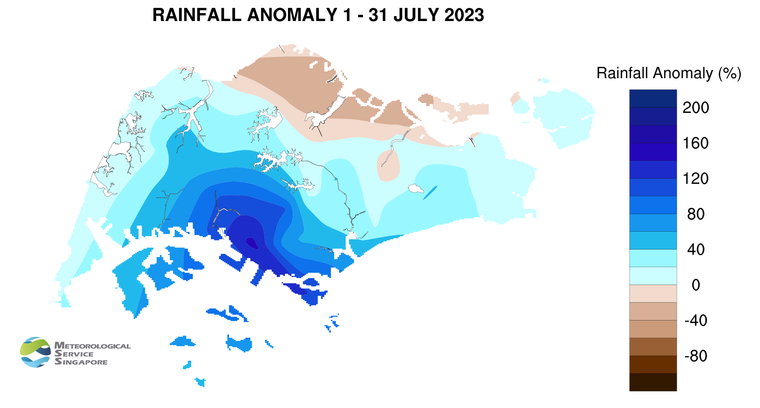
8     Most parts of Singapore recorded above average rainfall in July 2023. Kent Ridge recorded rainfall of 149 per cent above average, and Sembawang recorded rainfall of 37 per cent below average.


CLIMATE STATION STATISTICS

Long-term Statistics for August
(Climatological reference period: 1991 – 2020)

Average daily maximum temperature: 31.4 °C
Average daily minimum temperature: 25.3 °C
Average monthly temperature: 28.1 °C
Average rainfall: 146.9 mm
Average number of rain days: 14


Historical Extremes for August
(Rainfall since 1869 and temperature since 1929)

Highest monthly mean daily maximum temperature: 32.7 °C (2019)
Lowest monthly mean daily minimum temperature: 23.0 °C (1962)
Highest monthly rainfall ever recorded: 526.8 mm (1878)
Lowest monthly rainfall ever recorded: 11.8 mm (2019)


July 31, 2023

The National Institute Of Environmental Research Of The Republic Of Korea And The National Environment Agency Of Singapore Sign Memorandum Of Understanding

The MOU will enable both countries to share satellite air quality data and collaborate on R&D to address environmental and pollution issues

Singapore, 31 July 2023 – The Republic of Korea’s National Institute of Environmental Research (NIER) and Singapore’s National Environment Agency (NEA) signed a Memorandum of Understanding (MOU) today to share satellite observations of air quality and collaborate on research on its applications for addressing environmental and pollution issues such as climate change and transboundary air pollution. The MOU was signed in Singapore by President of NIER, Mr Kim Dongjin and the Chief Executive Officer of NEA, Mr Wong Kang Jet.

2               Air quality monitoring is crucial for understanding the causes and effects of air pollution, a major concern in Asia due to rapid population growth and urbanisation. Launched in 2020, NIER’s Geostationary Environment Monitoring Spectrometer (GEMS) onboard its GEO-KOMPSAT-2B satellite is the world’s first geostationary satellite instrument that focuses on air quality observations of atmospheric aerosols and gaseous pollutants, such as nitrogen dioxide, ozone, and sulphur dioxide. GEMS produces near-real time hourly daytime measurements of air quality over Asia, enabling scientists to study changes in atmospheric composition and better understand how air pollutants are transported. For more information on GEMS, please visit the NIER website here.

3               Under the MOU, NIER will share data from GEMS with NEA, while NEA will contribute to the validation and analysis of GEMS data through NIER’s Pan-Asia Partnership for Geospatial Air Pollution information (PAPGAPi) programme, facilitating the continued improvement of air quality observations over Asia. NIER and NEA will also undertake joint research on the potential applications of GEMS data, and explore the development of new space- and ground-based products for environmental monitoring, such as improved monitoring of regional smoke haze.

4               Mr Kim Dong Jin, President of NIER, said “We will do our best to support the wide utilisation of GEMS data for atmospheric monitoring and research activities in Asia.”

5               Mr Wong Kang Jet, CEO of NEA, said, “Climate change is a global challenge that can only be tackled through partnerships between countries and institutions. This collaboration is a good example of how we can work together across borders to build a better future. By accessing satellite-based air quality data through the GEMS initiative by the Republic of Korea, we will be able to develop new capabilities and products that can benefit Singapore and Southeast Asia. We look forward to working closely with NIER and partners from the Republic of Korea to further advance cooperation on environmental science and technology.”

July 17, 2023

Less Wet Weather Expected in the Second Half of July 2023

Singapore, 17 July 2023 – The prevailing Southwest Monsoon conditions are expected to persist over Singapore and the surrounding region in the coming fortnight, with low-level winds continuing to blow from the southeast or southwest.

2     Drier weather conditions are expected in the second half of July 2023 as compared to the first half of the month. The development of low pressure systems in the western Pacific Ocean and South China Sea may shift the rain band northwards and bring less rainfall to Singapore and the surrounding region. In the coming days, the passage of Sumatra squalls may bring widespread thundery showers and gusty winds on one to two mornings. Short-duration thundery showers are expected between the late morning and afternoon over parts of the island on some days. On the whole, we expect below average rainfall in the second half of July 2023. For the month of July, the total rainfall is expected to be near average over most parts of the island.

3     Warm conditions are expected on most days in the second fortnight of July 2023, with daily maximum temperatures ranging between 32 and 34 degrees Celsius. The daily maximum temperature could reach a high of around 35 degrees Celsius on one or two days. Several nights may also be warm, particularly when the prevailing winds blow from the southeast or south, and bring warm and humid air from the sea. Night-time temperatures of around 28 degrees Celsius can be expected on these nights, particularly over the south-eastern parts of the island.

4     For updates of the daily weather forecast, please visit the MSS website (https://www.weather.gov.sg), NEA website (www.nea.gov.sg), or download the myENV app.


REVIEW (1 – 16 July 2023)

5     Southwest Monsoon conditions prevailed over Singapore and the surrounding region in the first fortnight of July 2023, with low-level winds blowing mostly from the southeast or southwest.

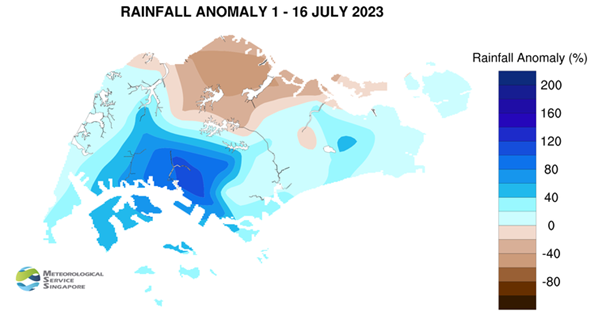
6     In the first fortnight of July 2023, localised short-duration thundery showers fell over parts of the island in the late morning and afternoon on most days. On 14 July 2023, convergence of winds over the surrounding region brought widespread thundery showers to Singapore in the morning and early afternoon. The daily total rainfall of 98.4 mm recorded at Kent Ridge that day was the highest rainfall recorded for the first half of July 2023.

7     The daily maximum temperatures in the first half of July 2023 were 34 degrees Celsius and below on all days except 4 and 5 July 2023. The highest daily maximum temperature of 35.4 degrees Celsius was recorded at Choa Chu Kang and Clementi on 5 July 2023. There were also several warm nights, particularly over the southern and eastern parts of the island where the minimum night-time temperatures ranged between 28 degrees Celsius and 29 degrees Celsius.

8     Most parts of Singapore recorded above average rainfall in the first half of July 2023. Kent Ridge recorded rainfall of 113 per cent above average, and Sembawang recorded rainfall of 56 per cent below average.


CLIMATE STATION STATISTICS

Long-term Statistics for July
(Climatological reference period: 1991 – 2020)

Average daily maximum temperature: 31.4 °C
Average daily minimum temperature: 25.4 °C
Average monthly temperature: 28.2 °C
Average rainfall: 146.6 mm
Average number of rain days: 14


Historical Extremes for July
(Rainfall since 1869 and temperature since 1929)

Highest monthly mean daily maximum temperature: 32.4 °C (1997)
Lowest monthly mean daily minimum temperature: 22.9 °C (1975)
Highest monthly rainfall ever recorded: 527.3 mm (1890)
Lowest monthly rainfall ever recorded: 12.2 mm (2019)


June 30, 2023

Wet Weather Expected to Continue in the First Half of July 2023

Singapore, 30 June 2023 – The prevailing Southwest Monsoon conditions are expected to persist over Singapore and the surrounding region in the first half of July 2023, with low-level winds blowing from the southeast or southwest.

2     In the first fortnight of July 2023, wet weather conditions are forecast over Singapore and the surrounding region. Short-duration thundery showers are expected between the late morning and afternoon over parts of the island on most days. On a few days, the passage of Sumatra squalls may bring widespread thundery showers and gusty winds between the pre-dawn and morning. The total rainfall for the first half of July 2023 is likely to be above average over most parts of the island.

3     While showers are expected in the coming fortnight, there could still be a few warm days with daily highs of slightly above 34 degrees Celsius. On most other days, the daily maximum temperature is likely to range between 32 degrees Celsius and 34 degrees Celsius. Several nights may be warm and humid, when the prevailing winds blow from the southeast or south bringing warm and moist air from the sea to Singapore. On these nights, the temperatures may stay above 28 degrees Celsius, particularly over the eastern and southern coastal areas of the island.

4      For updates of the daily weather forecast, please visit the MSS website (https://www.weather.gov.sg), NEA website (www.nea.gov.sg), or download the myENV app.


REVIEW (1 – 29 June 2023)

5    Southwest Monsoon conditions prevailed over Singapore and the surrounding region from early June 2023 with the prevailing winds blowing mostly from the southeast or southwest.

6    In June 2023, localised short-duration thundery showers fell over parts of the island on some afternoons. There were several days when Sumatra squalls brought widespread thundery showers and gusty winds over Singapore in the pre-dawn and morning. On 4 June 2023, widespread thundery showers from a Sumatra squall fell over many parts of Singapore in the late morning and early afternoon. The daily total rainfall of 96.2mm recorded at Toa Payoh that day was the highest daily rainfall for June 2023.

7    June 2023 was less warm compared to May 2023. The daily maximum temperature ranged between 32 and 34 degrees Celsius on most days. The highest daily maximum temperature of 34.7 degrees Celsius was recorded at Pulau Ubin and Ang Mo Kio on 2 June 2023 and 20 June 2023 respectively. There were also several warm nights where the minimum night-time temperatures remained above 28 degrees Celsius.

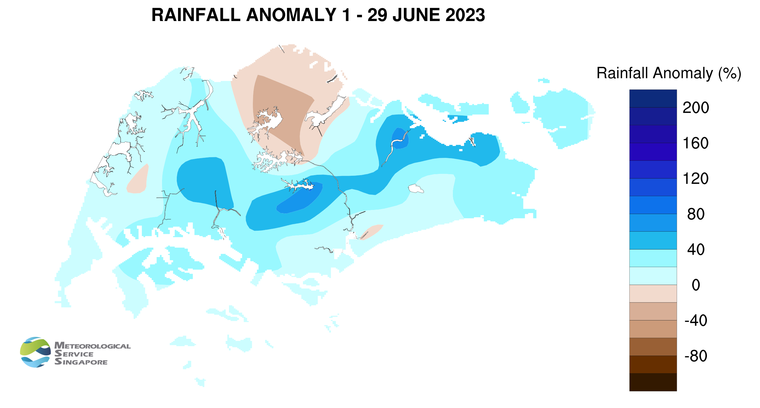
8     Most parts of Singapore recorded above average rainfall in June 2023. MacRitchie Reservoir recorded rainfall of 84 per cent above average, and Mandai recorded rainfall of 34 per cent below average.


CLIMATE STATION STATISTICS

Long-term Statistics for July
(Climatological reference period: 1991 – 2020)

Average daily maximum temperature: 31.4 °C
Average daily minimum temperature: 25.4 °C
Average monthly temperature: 28.2 °C
Average rainfall: 146.6 mm
Average number of rain days: 14


Historical Extremes for July
(Rainfall since 1869 and temperature since 1929)

Highest monthly mean daily maximum temperature: 32.4 °C (1997)
Lowest monthly mean daily minimum temperature: 22.9 °C (1975)
Highest monthly rainfall ever recorded: 527.3 mm (1890)
Lowest monthly rainfall ever recorded: 12.2 mm (2019)


June 1, 2023

More Warm Nights Expected with Onset of Southwest Monsoon Conditions

Singapore, 1 June 2023 – Low-level winds over Singapore and the surrounding region are forecast to strengthen and blow from the southeast or southwest in early June 2023, as the Southwest Monsoon progressively sets in over the region. The Southwest Monsoon season typically extends into September and is generally a drier season compared to other times of the year.

2     In the first fortnight of June 2023, localised short-duration thundery showers can be expected over parts of the island on some afternoons. In addition, Sumatra squalls may bring widespread thundery showers and gusty winds between the pre-dawn and morning on a few days. The total rainfall for the first half of June 2023 is likely to be near average over most parts of the island.

3     The daily maximum temperature in the next fortnight is forecast to range between 33 degrees Celsius and 34 degrees Celsius on most days. On one or two days when there is less cloud cover, the daily maximum temperature could reach a high of around 35 degrees Celsius. The nights are also expected to be warm and humid. Warm nights typically occur when the prevailing winds blow from the southeast or south and bring warm, humid air from the sea. On these nights, the temperatures may stay above 29 degrees Celsius, particularly over the southern and eastern coastal areas of the island.

4      For updates of the daily weather forecast, please visit the MSS website (https://www.weather.gov.sg), NEA website (www.nea.gov.sg), or download the myENV app.


REVIEW (1 – 31 May 2023)

5      Inter-monsoon conditions prevailed in May 2023 with the prevailing winds generally light and variable in direction.

6      Localised short-duration thundery showers fell over parts of Singapore in the afternoon on several days in May 2023. There were a few days when Sumatra squalls brought widespread thundery showers and gusty winds over the island in the morning. On 4 May 2023, strong solar heating of land areas coupled with localised convergence of winds led to the development of thundery showers over most parts of Singapore in the afternoon. The daily total rainfall of 113.2 mm which fell at Paya Lebar that day was the highest rainfall recorded for May 2023.

7      May 2023 was warm, with maximum temperatures above 34 degrees Celsius on most days. There were nine days in May registering temperatures of 35 degrees Celsius or more. Most of these days occurred in the first half of the month. It was especially warm in the second week of May 2023 when light winds and clear sky conditions resulted in high temperatures across many parts of Singapore. Warm night-time temperatures were also experienced during the second half of the month when the temperatures stayed above 29.0 degrees Celsius on some days.

8      On 13 May 2023, several locations recorded temperatures exceeding 36 degrees Celsius, with the highest temperature of 37.0 degrees Celsius measured at Ang Mo Kio. This temperature reading ties with the record for highest daily maximum temperature in Singapore (last recorded at Tengah on 17 April 1983) since temperature records started in 1929. On 25 May 2023, the daily minimum temperature recorded at the East Coast Parkway station reached a high of 29.7 degrees Celsius, the highest recorded for the month of May. The previous record was 29.5 degrees Celsius registered at the same station on 18 May 2022. At the Changi climate station, the mean temperature for May 2023 was 29.5 degrees Celsius, surpassing the previous record high of 29.4 degrees Celsius set in May 1998.

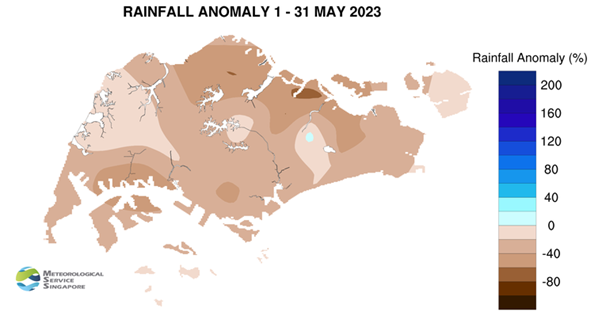
9      Most parts of Singapore recorded below average rainfall in May 2023. Paya Lebar recorded rainfall of nine per cent above average, and Punggol recorded rainfall of 64 per cent below average.


CLIMATE STATION STATISTICS

Long-term Statistics for June
(Climatological reference period: 1991 – 2020)

Average daily maximum temperature: 31.9 °C
Average daily minimum temperature: 25.7 °C
Average monthly temperature: 28.5 °C
Average rainfall: 135.3 mm
Average number of rain days: 13


Historical Extremes for June
(Rainfall since 1869 and temperature since 1929)

Highest monthly mean daily maximum temperature: 33.2 °C (1997)
Lowest monthly mean daily minimum temperature: 23.2 °C (1965)
Highest monthly rainfall ever recorded: 378.7 mm (1954)
Lowest monthly rainfall ever recorded: 21.8 mm (2009)


March 31, 2023

More Warm Days Expected in First Half of April 2023 with Onset of Inter-Monsoon Conditions

Singapore, 31 March 2023 – The Northeast Monsoon conditions prevailing over the region since December 2022 are expected to gradually weaken and end with the onset of inter-monsoon conditions in the first half of April 2023. The prevailing low-level winds over the equatorial Southeast Asia region including Singapore, are forecast to become variable in direction on most days. Brief intensification of high-pressure systems over the Western Pacific Ocean may bring easterly winds to Singapore and the surrounding region on some days.

2      The inter-monsoon period is characterised by warm weather and thunderstorms that can at times be heavy.  Lightning activity tends to be higher during the inter-monsoon months than other months of the year. The inter-monsoon period is forecast to persist through May 2023.

3      In the coming fortnight, the monsoon rain band is forecast to lie close to the equatorial Southeast Asia region. Moderate to heavy thundery showers with frequent lightning are expected over parts of the island in the afternoon on most days. On a few of these days, particularly when there is strong convergence of winds in the surrounding vicinity, the thundery showers could extend into the early evening. In addition, Sumatra squalls developing in the Strait of Malacca may bring widespread moderate to heavy thundery showers with occasional gusty winds over Singapore in the pre-dawn hours or mornings on a few days. Less rainfall can be expected in the second week of April 2023, compared to the first week. Overall, the rainfall for the first fortnight of April 2023 is expected to be near average over most parts of the island.

4      While wet weather can be expected in the coming fortnight, the daily maximum temperature could still reach a high of around 35 degrees Celsius on a few days. On most days, the daily temperature is forecast to range between 24 degrees Celsius and 34 degrees Celsius. In addition, the Sumatra squalls may bring cooler daily temperatures of between 23 degrees Celsius and 32 degrees Celsius on a few days.

5       For updates of the daily weather forecast, please visit the MSS website (https://www.weather.gov.sg), NEA website (www.nea.gov.sg), or download the myENV app.


REVIEW (1 – 30 March 2023)

6      Northeast Monsoon conditions prevailed over Singapore and the surrounding region in March 2023. The prevailing low-level winds blew from the northwest or northeast on most days.

7      A high-pressure system over northern continental Asia brought a surge of moderate to strong northeast monsoon winds (monsoon surge[1]) over the equatorial South China Sea region in the first few days of March 2023. The surge that affected Singapore and the surrounding region in end February 2023 continued into 1 March 2023 and brought a daily total rainfall of 104.4mm to the Seng Kang area on that day. On 3-4 March 2023, another monsoon surge brought widespread moderate to heavy rain over Singapore and the surrounding region. After a wet start in the first week of March 2023, there were a few dry and warm days in the second week of March 2023. In the second half of the month, Singapore experienced thundery showers in the afternoon on most days due to strong day-time heating of land areas coupled with convergence of winds either over Singapore or the surrounding vicinity. On 30 March 2023, moderate to heavy thundery showers fell in the late afternoon and evening resulting in a daily total rainfall of 117.4 mm recorded around the Henderson area, and the highest daily total rainfall registered for March 2023.

8      The daily temperature in March 2023 ranged from 21.1 degrees Celsius to 34.9 degrees Celsius. The highest daily maximum temperature of 34.9 degrees Celsius was recorded on 23 March 2023 at Choa Chu Kang.  During the monsoon surges in the first week of March 2023, there were three days where the highest daily maximum temperature was below 28 degrees Celsius. On 3 and 4 March 2023, the highest daily maximum temperature only reached 26.1 degrees Celsius at East Coast Parkway. The temperature at Newton dipped to 21.1 degrees Celsius during the monsoon surge on 1 March 2023. That was the lowest daily minimum temperature for March 2023.

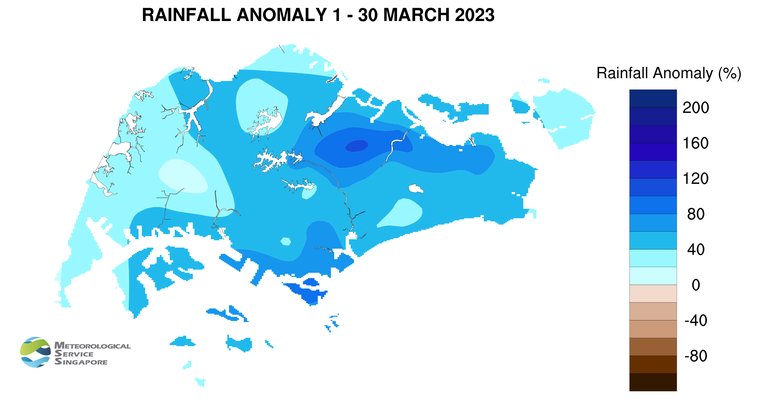
9       Above average rainfall was received across the island in March 2023. The highest anomaly of 110 per cent above average was recorded at Yio Chu Kang. The anomaly was lowest around Jurong West at 5 per cent above average.


[1] A monsoon surge refers to a strengthening of winds over the South China Sea, causing extensive rainclouds to form over our surrounding region. Read more at https://www.weather.gov.sg/learn_weather_systems/


CLIMATE STATION STATISTICS

Long-term Statistics for April
(Climatological reference period: 1991 – 2020)

Average daily maximum temperature: 32.4 °C
Average daily minimum temperature: 25.3 °C
Average monthly temperature: 28.2 °C
Average rainfall: 164.3 mm
Average number of rain days: 15


Historical Extremes for March
(Rainfall since 1869 and temperature since 1929)

Highest monthly mean daily maximum temperature: 33.9 °C (1983)
Lowest monthly mean daily minimum temperature: 23.1 °C (1934)
Highest monthly rainfall ever recorded: 454.9 mm (1900)
Lowest monthly rainfall ever recorded: 16.6 mm (1977)


February 1, 2023

Less Wet Weather and More Sunshine Expected in the Next Fortnight

Singapore, 1 February 2023 – The prevailing Northeast Monsoon conditions are forecast to continue into the first half of February 2023, with the low-level winds blowing from the northwest or northeast.

2          The wet and cool weather conditions experienced in the second half of January 2023 are likely to gradually ease and more sunshine is expected in the first fortnight of February 2023. However, with the monsoon rain band forecast to remain close to the equatorial region, short-duration thundery showers can still be expected over parts of Singapore in the afternoon on most days. The showers may extend into the evening on some days. Overall, the total rainfall for the first fortnight of February 2023 is forecast to be above average over most parts of Singapore.

3          During the fortnight, the daily temperature is expected to range between 24 degrees Celsius and 33 degrees Celsius on most days, and may reach around 34 degrees Celsius on a few days when there is less cloud cover.

4          For updates of the daily weather forecast, please visit the MSS website (https://www.weather.gov.sg), NEA website (www.nea.gov.sg), or download the myENV app.


REVIEW (1 – 31 January 2023)

5          Northeast Monsoon conditions prevailed over Singapore and the surrounding region in January 2023. The low-level winds blew from the northwest or northeast during this period.

6          The second half of January 2023 was much wetter compared to the first half of the month. Over the Lunar New Year period, the strengthening of high-pressure systems over the northern Asian continent brought a surge of strong north-easterly winds (or monsoon surge[1]) over the South China Sea. Singapore and the surrounding vicinity experienced cool and rainy weather from two monsoon surges on 22-25 January 2023 and 28-29 January 2023. The monsoon surges brought widespread continuous rain over Singapore and the surrounding region. The rain was heaviest on 25 January 2023 with the highest daily total rainfall of 120.0mm recorded at Changi East. This was the highest daily total rainfall for January 2023.

7          The monsoon surges also brought cool weather to Singapore in the second half of January 2023. There were four days where the highest daily maximum temperature was below 27 degrees Celsius. On 25 January 2023, the highest daily maximum temperature only reached 25.7 degrees Celsius at East Coast Parkway. The daily minimum temperature dropped to below 23 degrees Celsius on nine days in January 2023. The lowest daily minimum temperature for January 2023 was 22.3 degrees Celsius recorded on 12, 22, 24 and 25 January 2023.

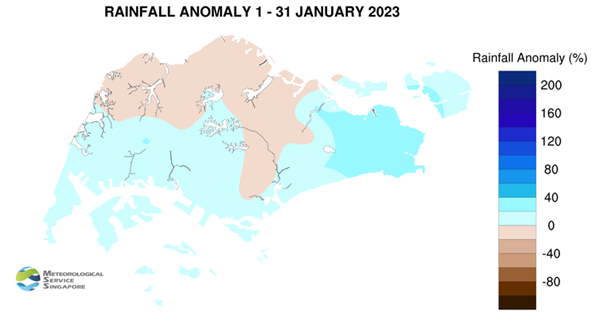
8          Singapore received near average rainfall in January 2023. The highest anomaly of 36 per cent above average was recorded at Changi. The anomaly was lowest at Seletar at 20 per cent below average.


[1] A monsoon surge refers to a strengthening of winds over the South China Sea, causing extensive rainclouds to form over our surrounding region. Read more at https://www.weather.gov.sg/learn_weather_systems/


CLIMATE STATION STATISTICS

Long-term Statistics for February
(Climatological reference period: 1991 – 2020)

Average daily maximum temperature: 31.5 °C
Average daily minimum temperature: 24.6 °C
Average monthly temperature: 27.3 °C
Average rainfall: 105.1 mm
Average number of rain days: 9


Historical Extremes for February
(Rainfall since 1869 and temperature since 1929)

Highest monthly mean daily maximum temperature: 33.5 °C (2010)
Lowest monthly mean daily minimum temperature: 21.6 °C (1930, 1934)
Highest monthly rainfall ever recorded: 566.7 mm (1910)
Lowest monthly rainfall ever recorded: 0.2 mm (2014)

January 16, 2023

Wet and Cool Conditions Likely During the Lunar New Year Period

Singapore, 16 January 2023 – The Northeast Monsoon conditions prevailing over the region are forecast to persist into the second half of January 2023, with low-level winds blowing from the northwest or northeast. During the Lunar New Year period, a high-pressure system over the northern Asian continent is likely to strengthen and bring wetter and cooler conditions to the region.

2          The next two weeks of January 2023 are expected to be wetter than the first fortnight of the year. Over the Lunar New Year period, a possible strengthening of a high-pressure system over the northern Asian continent could bring a surge of strong north-easterly winds (or monsoon surge[1]) over the South China Sea. The surge is likely to last for a few days and may bring cooler conditions with spells of showers over Singapore and the surrounding vicinity. The rainy weather is likely to ease in the last week of the month with localised short-duration thundery showers to be expected in the afternoon. Overall, above average rainfall can be expected for the second half of January 2023 and the total rainfall for the month is likely be near average over most parts of the island.

3          In the second half of January 2023, the daily temperature is forecast to range between 24 degrees Celsius and 32 degrees Celsius on most days, and may reach a high of 33 degrees Celsius on a few days. The rainy weather during the monsoon surge period is likely to result in lower daily temperatures of between 22 degrees Celsius and 30 degrees Celsius on a few days.

4      For updates of the daily weather forecast, please visit the MSS website (https://www.weather.gov.sg), NEA website (www.nea.gov.sg), or download the myENV app.


REVIEW (1 – 15 January 2023)

5          Northeast Monsoon conditions prevailed over Singapore and the surrounding region in the first half of January 2023. The low-level winds blew from the northwest or northeast during this period.

6          There were less showers in the first half of January 2023 compared to the second half December 2022. On several days in the first two weeks of 2023, strong solar heating of land areas coupled with localised convergence of winds brought short-duration thundery showers, mostly in the afternoon. The thundery showers that fell over many areas of the island on 15 January 2023 resulted in a daily total rainfall of 47.4mm around Bedok North area.  This was the highest total rainfall in a day for the first half of January 2023.

7          It was also relatively cool in the first half of January 2023 with only two days when the daily maximum temperature was higher than 34 degrees Celsius. The highest daily maximum temperature of 34.8 degrees Celsius was recorded at Paya Lebar on 8 January 2023. In the first two weeks of 2023, the daily minimum temperature ranged between 23 degrees Celsius and 24 degrees Celsius on most days. The lowest minimum temperature recorded during the period was 22.3 degrees Celsius on 12 January 2023 at Sembawang.

8          Singapore received well below average rainfall in the first fortnight of January 2023. The highest anomaly of 90 per cent below average was recorded at Bukit Panjang. The anomaly was lowest at Chai Chee at 30 per cent below average.


[1] A monsoon surge refers to a strengthening of winds over the South China Sea, causing extensive rainclouds to form over our surrounding region. Read more at https://www.weather.gov.sg/learn_weather_systems/


CLIMATE STATION STATISTICS

Long-term Statistics for January
(Climatological reference period: 1991 – 2020)

Average daily maximum temperature: 30.6 °C
Average daily minimum temperature: 24.3 °C
Average monthly temperature: 26.8 °C
Average rainfall: 221.6 mm
Average number of rain days: 13


Historical Extremes for January
(Rainfall since 1869 and temperature since 1929)

Highest monthly mean daily maximum temperature: 31.8 °C (1998, 2016)
Lowest monthly mean daily minimum temperature: 21.6 °C (1934)
Highest monthly rainfall ever recorded: 818.6 mm (1893)
Lowest monthly rainfall ever recorded: 15.4 mm (1997)

December 1, 2021

Windy Conditions with the Start of Northeast Monsoon

Singapore, 1 December 2021 – Inter-monsoon conditions prevailed over Singapore in November 2021, with the winds generally light and variable in direction. In the first half of December 2021, the winds around Singapore are expected to strengthen and shift to blow from the northwest or northeast. This change in monsoonal winds signal the start of the Northeast Monsoon season which is expected to extend into March 2022.

2    Climatologically, December is the wettest month of the year. In the first half of December 2021, the strengthening of the high-pressure system over the northern Asian continent is expected to bring northeast monsoonal winds over the South China Sea and equatorial Southeast Asia region, including Singapore. The monsoon rain band is forecast to lie close to the equator and bring shower activities to the surrounding region of Singapore. Singapore can expect short-duration moderate to heavy thundery showers over parts of the island in the afternoon on most days. The showers may extend into the evening on occasions. On a few days during the fortnight, Singapore may experience occasionally windy conditions. During this time, fair weather with brief periods of passing showers can be expected. The rainfall for the first fortnight of December 2021 is expected to be below-average over most parts of Singapore.

3     During the fortnight, the daily temperature is forecast to range between 24°C and 33°C on most days and may reach 34°C on some days when there is little or no cloud cover. On one or two rainy days, daily lows of around 22°C can be expected.

4      For updates of the daily weather forecast, please visit our MSS website (https://www.weather.gov.sg), NEA website (www.nea.gov.sg), or download the myENV app.


REVIEW (1 –  30 November 2021)

5     In November 2021, inter-monsoon conditions prevailed over Singapore. The low-level winds were generally light and blew mainly from the west or northwest.

6     Singapore experienced short-duration moderate to heavy afternoon thundery showers on most days in November 2021. The showers extended into the evening on a few occasions. On some days, the convergence of low-level winds in the surrounding region of Singapore led to the development of Sumatra squalls over the Strait of Malacca. The Sumatra squalls brought widespread showers with occasional gusty winds over Singapore between the early hours and morning. On 12 November 2021, the lowest minimum temperature of 22.1°C was recorded at Newton following cool and cloudy weather brought about by the passage of a Sumatra squall.

7     On 4 November 2021, strong solar heating of land areas coupled with convergence of winds in the surrounding region led to heavy rain over some parts of Singapore. A total of 118.2mm of rainfall was recorded at Sembawang that day. This was the highest daily rainfall recorded for November 2021.

8     In November 2021, there were 12 days where the daily maximum temperature was 34°C or higher. The passage of dry air mass brought relatively fair and warm weather to the surrounding region of Singapore around the end of November 2021. On 30 November 2021, the daily maximum temperature at Paya Lebar reached a high of 35.4°C.

9    In November 2021, rainfall was mostly below average over the western half of Singapore, and above average over the eastern parts of the island. The highest anomaly of 47% above average was recorded at Simei. The rainfall anomaly at Tuas was 38% below average.


CLIMATE STATION STATISTICS

Long-term Statistics for December
(Climatological reference period: 1991 – 2020)

Average daily maximum temperature: 30.5 °C
Average daily minimum temperature: 24.3 °C
Average monthly temperature: 26.8 °C
Average rainfall: 331.9 mm
Average number of rain days: 19


Historical Extremes for December
(Rainfall since 1869 and temperature since 1929)

Highest monthly mean daily maximum temperature: 31.6 °C (2016, 2018)
Lowest monthly mean daily minimum temperature: 21.9 °C (1933)
Highest monthly rainfall ever recorded: 765.9 mm (2006)
Lowest monthly rainfall ever recorded: 62.5 mm (1932)


November 16, 2021

Wet Weather to Continue for the Second Half of November 2021

Singapore, 16 November 2021 – Inter-monsoon conditions with low-level winds that are light and variable in direction, are expected to continue for most of November 2021.  Towards the end of the month, the winds are forecast to gradually strengthen and shift to blow from the northeast or northwest.

2    The monsoon rain band is forecast to continue to lie over the equatorial Southeast Asia region for the rest of the month. During this period, short-duration moderate to heavy thundery showers are expected over parts of the island in the afternoon on most days. On some of these days, the thundery showers could extend into the evening. The thundery showers may be intense on one or two days as prevailing winds converge around the surrounding region of Singapore. On a few occasions, convergence of winds from the southwest or west over the Strait of Malacca may trigger the development of Sumatra squalls. The squalls are expected to bring widespread thundery showers and gusty winds over Singapore between the pre-dawn hours and morning as they move eastward toward the South China Sea. While the second half of November 2021 is not expected to be as wet as the first half, the overall rainfall for the month is forecast to be above average over most parts of Singapore.

3     In the second fortnight of November 2021, the daily temperature is forecast to range between 24°C and 33°C on most days, and may reach around 34°C on some days when there is less cloud cover.

4      For updates of the daily weather forecast, please visit our MSS website (https://www.weather.gov.sg), NEA website (www.nea.gov.sg), or download the myENV app.


REVIEW (1 –  15 November 2021)

5     In the first fortnight of November 2021, inter-monsoon conditions prevailed over Singapore, with prevailing winds generally light and variable in direction. On some days, the low-level winds shifted to blow from the southwest or west.

6     The monsoon rain band was located over the equatorial Southeast Asia region, and brought wet weather over Singapore on most days. Thundery showers occurred over most parts of Singapore mainly in the afternoon. On a few days, the passage of Sumatra squalls brought widespread showers with occasional gusty winds to Singapore between the early hours and morning. On 4 November 2021, strong solar heating of land areas coupled with convergence of winds in the surrounding region led to the development of intense thundery showers over Singapore. A total of 118.2mm of rainfall was recorded at Sembawang that day. This was the highest daily rainfall recorded for the first half of November 2021.

7      In the first half of November 2021, there were 5 days when the daily maximum temperature was 34°C or higher. The highest daily maximum temperature of 34.8°C was recorded at Paya Lebar on 14 November 2021. On 12 November 2021, the passage of a Sumatra squall brought cool and cloudy weather to Singapore, and the minimum temperature at Newton dropped to a low of 22.1°C.

8      Most parts of the island received near to above average rainfall in November 2021, except in western Singapore where the rainfall was below average. The highest anomaly of 58% above average rainfall was recorded at Sembawang, while 29% below average rainfall was recorded at Boon Lay.


CLIMATE STATION STATISTICS

Long-term Statistics for November
(Climatological reference period: 1991 – 2020)

Average daily maximum temperature: 31.2 °C
Average daily minimum temperature: 24.6 °C
Average monthly temperature: 27.2 °C
Average rainfall: 252.3 mm
Average number of rain days: 19


Historical Extremes for November
(Rainfall since 1869 and temperature since 1929)

Highest monthly mean daily maximum temperature: 32.3 °C (2019)
Lowest monthly mean daily minimum temperature: 22.4 °C (1933)
Highest monthly rainfall ever recorded: 521.5 mm (1874)
Lowest monthly rainfall ever recorded: 53.5 mm (1981)