Category Archives: News

March 16, 2026

More Warm Days Expected in Second Half of March 2026

16 March 2026 – The prevailing Northeast Monsoon conditions are expected to continue for the rest of March 2026, with winds blowing mainly from the northwest or northeast.

2    In the second half of March 2026, short-duration thundery showers are expected over parts of the island in the afternoon on some days. Towards the final week of the month, there may be  several dry and warm days. The second half of March 2026 is likely to be less wet than the first, and the total rainfall is forecast to be below average over most parts of the island.

3    More warm days are expected in the second half of March 2026 compared to the first. The daily maximum temperatures are likely to range between 34 degrees Celsius and 35 degrees Celsius on most days. On a few days, the daily maximum temperatures may exceed 35 degrees Celsius when there is less cloud coverage.

4    For updates of the daily weather forecast, please visit the MSS website (https://www.weather.gov.sg), NEA website (www.nea.gov.sg), or download the myENV app.

REVIEW OF THE PAST TWO WEEKS (1 – 15 March 2026)

5   Northeast Monsoon conditions prevailed over Singapore and the surrounding region in the first half of March 2026. During this period, the low-level winds blew mainly from the northwest or northeast.

6   Thundery showers fell over parts of the island on some afternoons, extending into the evening on a few occasions. Strong solar heating coupled with convergence of winds brought heavy thundery showers over the southern and western parts of Singapore in the late afternoon and evening of 6 March 2026. The daily total rainfall of 74.4 mm recorded around Clementi Stadium that day was the highest rainfall recorded for the first half of March 2026.

7   The daily maximum temperatures in the first half of March 2026 were around 34 degrees Celsius on most days. The highest daily maximum temperature of 35.3 degree Celsius was recorded at Sentosa Island on 11 March 2026.

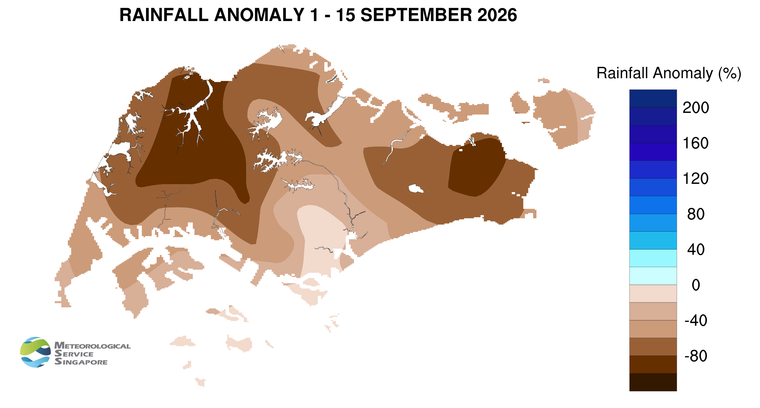
8   Most parts of Singapore recorded below average rainfall in the first half of March 2026. The area around Sembawang registered rainfall of 71 per cent below average, and the area around Somerset registered rainfall of 15 per cent above average.


CLIMATE STATION STATISTICS

Long-term Statistics for March
(Climatological reference period: 1991 – 2020)

Average daily maximum temperature: 32.2 °C
Average daily minimum temperature: 24.9 °C
Average monthly temperature: 27.8 °C
Average rainfall: 151.7 mm
Average number of rain days: 12

Historical Extremes for March
(Rainfall since 1869 and temperature since 1929)

Highest monthly mean daily maximum temperature: 34.1 °C (1998)
Lowest monthly mean daily minimum temperature: 22.1 °C (1934)
Highest monthly rainfall ever recorded: 528.3 mm (1913)
Lowest monthly rainfall ever recorded: 6.2 mm (2016)

March 2, 2026

Thundery Showers on Most Afternoons in the First Fortnight of March 2026

2 March 2026 – The prevailing Northeast Monsoon conditions are expected to continue in the first fortnight of March 2026, with winds blowing mainly from the northwest or northeast.

2    Thundery showers are forecast over parts of the island in the afternoon on most days. The showers may extend into the evening on a few of these days. The total rainfall for the first fortnight of March 2026 is forecast to be near average over most parts of the island.

3    The daily maximum temperatures are likely to range between 33 degrees Celsius and 34 degrees Celsius on most days and reach around 35 degrees Celsius on a few days.

4    For updates of the daily weather forecast, please visit the MSS website (https://www.weather.gov.sg), NEA website (www.nea.gov.sg), or download the myENV app.

REVIEW OF THE PAST TWO WEEKS (16 – 28 February 2026)

5   Northeast Monsoon conditions prevailed over Singapore and the surrounding region in the second fortnight of February 2026. During this period, the low-level winds blew mainly from the northwest or northeast.

6   The second fortnight of February 2026 was wet, particularly in the first few days. Thundery showers fell over parts of the island in the afternoon on most days, extending into the evening on some days. Strong convergence of winds over the region in the first few days of the fortnight resulted in dense cloud formation, heavy rain and cooler temperatures over Singapore. On 19 February 2026, widespread heavy thundery showers affected Singapore in the afternoon and evening. The daily total rainfall of 148.6mm recorded at Margaret Drive that day was the highest rainfall recorded for the second fortnight of February 2026.

7   The daily maximum temperatures in the second fortnight of February 2026 were above 32 degrees Celsius on most days. The highest daily maximum temperature of 35.2 degrees Celsius was recorded at Admiralty on 28 February 2026. The lowest daily minimum temperature of 20.3 degree Celsius was recorded at Newton during the heavy rain event on 19 February 2026.

8   Singapore recorded well above average rainfall in the second fortnight of February 2026. Ulu Pandan registered rainfall of about 530 per cent above average.

Figure 1: 

Figure 2: 

Figure 3: 


CLIMATE STATION STATISTICS

Long-term Statistics for March
(Climatological reference period: 1991 – 2020)

Average daily maximum temperature: 32.2 °C
Average daily minimum temperature: 24.9 °C
Average monthly temperature: 27.8 °C
Average rainfall: 151.7 mm
Average number of rain days: 12

Historical Extremes for March
(Rainfall since 1869 and temperature since 1929)

Highest monthly mean daily maximum temperature: 34.1 °C (1998)
Lowest monthly mean daily minimum temperature: 22.1 °C (1934)
Highest monthly rainfall ever recorded: 528.3 mm (1913)
Lowest monthly rainfall ever recorded: 6.2 mm (2016)

February 26, 2026

Change in Station Names

We have updated the names of some weather observation stations to accommodate the expansion of our weather observation network. With more stations in some towns, station names have been updated to reflect either the road name or the nearest landmark. Please refer to go.gov.sg/station-summary for a summary of the updated station names.

February 16, 2026

More Thundery Showers Expected in the Early Fortnight

16 February 2026 – The prevailing Northeast Monsoon conditions are expected to continue in the second fortnight of February 2026, with winds blowing mainly from the northwest or northeast.

2    Moderate to heavy thundery showers are forecast over most parts of the island in the afternoon and evening during the first few days of the second fortnight of February 2026. Following this period, conditions are expected to turn relatively drier, though brief localised thundery showers may still occur on several afternoons. A few dry days may be expected. Overall, the total rainfall for the second fortnight of February 2026 is expected to be near average across most parts of the island.

3    The daily maximum temperatures are likely to range between 32 degrees Celsius and 33 degrees Celsius on most days, with high of around 34 degrees Celsius on a few days.

4    For updates of the daily weather forecast, please visit the MSS website (https://www.weather.gov.sg), NEA website (www.nea.gov.sg), or download the myENV app.

REVIEW OF THE PAST TWO WEEKS (1 – 15 February 2026)

5   Northeast Monsoon conditions prevailed over Singapore and the surrounding region in the first fortnight of February 2026. During this period, the low-level winds blew from the north or northeast.

6   The first fortnight of February 2026 saw more showers compared to the second half of January 2026. Localised, short-duration showers occurred over parts of the island on several afternoons. On 5 February 2026, widespread thundery showers affected many areas, resulting in a daily total rainfall of 108.6 mm around the Jurong Pier area. This was the highest daily rainfall recorded in the first fortnight of February 2026.

7   During the first fortnight of February 2026, daily maximum temperatures generally ranged from about 32 degrees Celsius to 33 degrees Celsius. On several occasions, the maximum temperature exceeded 34 degrees Celsius, with the highest reading of 34.7 degrees Celsius recorded at Jurong Island on 4 February 2026.

8   Most parts of Singapore recorded below average rainfall in the first fortnight of February 2026. The area around Bedok North registered rainfall of 88 per cent below average, and the area around Jurong Pier registered rainfall of 89 per cent above average.


CLIMATE STATION STATISTICS

Long-term Statistics for February
(Climatological reference period: 1991 – 2020)

Average daily maximum temperature: 31.5 °C
Average daily minimum temperature: 24.6 °C
Average monthly temperature: 27.3 °C
Average rainfall: 105.1 mm
Average number of rain days: 9

Historical Extremes for February
(Rainfall since 1869 and temperature since 1929)

Highest monthly mean daily maximum temperature: 33.5 °C (2010)
Lowest monthly mean daily minimum temperature: 21.6 °C (1930, 1934)
Highest monthly rainfall ever recorded: 566.7 mm (1910)
Lowest monthly rainfall ever recorded: 0.2 mm (2014)

February 2, 2026

Thundery Showers Expected to Return in the Middle of This Week

2 February 2026 – The prevailing Northeast Monsoon conditions are expected to continue in the first fortnight of February 2026, with winds blowing mainly from the northwest or northeast.

2    Wet weather is likely to return in the middle of first week of February 2026, with thundery showers expected over parts of the island in the afternoon on most days. The showers may extend into the evening on a few of these days. The total rainfall for the first fortnight of February 2026 is forecast to be near average over most parts of the island.

3    The daily maximum temperatures are likely to range between 32 degrees Celsius and 34 degrees Celsius on most days.

4    For updates of the daily weather forecast, please visit the MSS website (https://www.weather.gov.sg), NEA website (www.nea.gov.sg), or download the myENV app.

REVIEW OF THE PAST TWO WEEKS (16 – 31 January 2026)

5   Northeast Monsoon conditions prevailed over Singapore and the surrounding region in the second fortnight of January 2026. During this period, the low-level winds blew from the north or northeast.

6   Singapore and the surrounding region experienced dry weather in the second fortnight of January 2026. Localised short-duration showers fell over parts of the island in the afternoon on a few days. On 16 January 2026, moderate to heavy showers affected the southern and western parts of Singapore in the late afternoon and evening. The daily total rainfall of 54.8mm recorded at Lim Chu Kang that day was the highest rainfall recorded for the second fortnight of January 2026.

7   The daily maximum temperatures in the second fortnight of January 2026 were between 32 degrees Celsius and 33 degrees Celsius on most days. The highest daily maximum temperature of 33.5 degree Celsius was recorded at Jurong Island on 24 January 2026 and at Paya Lebar on 31 January 2026.

8   Singapore recorded well below average rainfall in the second fortnight of January 2026. Changi registered rainfall of about 99 per cent below average.


Figure 1:
Figure 2:

Figure 3: 


CLIMATE STATION STATISTICS

Long-term Statistics for February
(Climatological reference period: 1991 – 2020)

Average daily maximum temperature: 31.5 °C
Average daily minimum temperature: 24.6 °C
Average monthly temperature: 27.3 °C
Average rainfall: 105.1 mm
Average number of rain days: 9

Historical Extremes for February
(Rainfall since 1869 and temperature since 1929)

Highest monthly mean daily maximum temperature: 33.5 °C (2010)
Lowest monthly mean daily minimum temperature: 21.6 °C (1930, 1934)
Highest monthly rainfall ever recorded: 566.7 mm (1910)
Lowest monthly rainfall ever recorded: 0.2 mm (2014)

January 16, 2026

Below-average Rainfall Expected for the Rest of January 2026

Singapore, 16 January 2026 – The prevailing Northeast Monsoon conditions are expected to continue into the second fortnight of January 2026, with the low-level winds over Singapore and the surrounding region blowing mostly from the northeast or northwest.

2    Moderate to heavy thundery showers are expected over most parts of the island in the afternoon and evening on the first few days of the second fortnight of January 2026. Thereafter, conditions should turn relatively drier, though brief localised thundery showers may still occur on several afternoons. A few days may be dry and occasionally windy. Overall, rainfall for the second fortnight of January 2026 is forecast to be below average across most parts of the island.

3    For the rest of January 2026, the daily maximum temperatures are likely to range between 32 degrees Celsius and 33 degrees Celsius on most days and may reach around 34 degrees Celsius on a few days.

4    For updates of the daily weather forecast, please visit the MSS website (https://www.weather.gov.sg), NEA website (www.nea.gov.sg), or download the myENV app.

REVIEW OF THE PAST TWO WEEKS (1 – 15 January 2026)

5    Northeast Monsoon conditions prevailed over Singapore and the surrounding region in the first half of January 2026. During this period, the low-level winds blew from the northwest or northeast.

6    The Northeast Monsoon brought relatively dry and windy conditions to Singapore and the surrounding region on most days in the first two weeks of 2026. Short-duration thundery showers fell over parts of the island in the afternoon on some days. On 7 January 2026, heavy thundery showers affected the southern, western and central parts of Singapore in the afternoon and evening. The daily total rainfall of 81.6 mm recorded at Jurong Island that day was the highest rainfall recorded for the first half of January 2026.

7    The first half of January 2026 was relatively cool with daily maximum temperatures below 33 degrees Celsius on all days. The highest daily maximum temperature of 32.7 degree Celsius was recorded at Tuas South, Choa Chu Kang, and Jurong Island on 1, 5, and 13 January 2026 respectively.

8    Most parts of the island recorded well below-average rainfall in the first half of January 2026. The area around Ang Mo Kio registered rainfall of 93 per cent below-average, and the area around Jurong Pier registered rainfall of 78 per cent above-average.


CLIMATE STATION STATISTICS

Long-term Statistics for January
(Climatological reference period: 1991 – 2020)

Average daily maximum temperature: 30.6 °C
Average daily minimum temperature: 24.3 °C
Average monthly temperature: 26.8 °C
Average rainfall: 221.6 mm
Average number of rain days: 13

Historical Extremes for January
(Rainfall since 1869 and temperature since 1929)

Highest monthly mean daily maximum temperature: 31.8 °C (2016, 2018)
Lowest monthly mean daily minimum temperature: 21.9 °C (1933)
Highest monthly rainfall ever recorded: 818.6 mm (2006)
Lowest monthly rainfall ever recorded: 15.4 mm (1932)

January 2, 2026

Mostly Afternoon Thundery Showers in the First Fortnight of January 2026

Singapore, 2 January 2026 – The prevailing Northeast Monsoon conditions are expected to continue in the first fortnight of January 2026, with winds blowing mainly from the northwest or northeast.

2    Thundery showers are expected over parts of the island in the afternoon on most days. The showers may extend into the evening on a few of these days. The total rainfall for the first fortnight of January 2026 is forecast to be below average over most parts of the island.

3    The daily maximum temperatures are likely to range between 32 degrees Celsius and 34 degrees Celsius on most days and slightly exceed 34 degrees Celsius on a few days.

4    For updates of the daily weather forecast, please visit the MSS website (https://www.weather.gov.sg), NEA website (www.nea.gov.sg), or download the myENV app.

REVIEW OF THE PAST TWO WEEKS (16 – 31 DECEMBER 2025)

5    Northeast Monsoon conditions prevailed over Singapore and the surrounding region in the second fortnight of December 2025. During the period, the low-level winds blew mainly from the northwest or northeast.

6    Thundery showers fell over parts of the island on most afternoons, extending into the evening on a few days. On 26 December 2025, heavy thundery showers affected the southern, western and central parts of Singapore in the afternoon. The daily total rainfall of 98.4 mm recorded at Pasir Laba that day was the highest rainfall recorded for the second fortnight of December 2025.

7    The daily maximum temperatures in the second fortnight of December 2025 were between 32 degrees Celsius and 34 degrees Celsius on most days. The highest daily maximum temperature of 34.7 degree Celsius was recorded at Jurong Island on 24 December 2025.

8    Singapore recorded well below average rainfall in the second fortnight of December 2025. Sembawang registered rainfall of about 80 per cent below average.


Figure 1:

Figure 2:

Figure 3:

CLIMATE STATION STATISTICS

Long-term Statistics for January
(Climatological reference period: 1991 – 2020)

Average daily maximum temperature: 30.6 °C
Average daily minimum temperature: 24.3 °C
Average monthly temperature: 26.8 °C
Average rainfall: 221.6 mm
Average number of rain days: 13

Historical Extremes for January
(Rainfall since 1869 and temperature since 1929)

Highest monthly mean daily maximum temperature: 31.8 °C (2016, 2018)
Lowest monthly mean daily minimum temperature: 21.9 °C (1933)
Highest monthly rainfall ever recorded: 818.6 mm (2006)
Lowest monthly rainfall ever recorded: 15.4 mm (1932)

December 16, 2025

Wet Weather to Continue for Rest of December 2025

Singapore, 16 December 2025 – The prevailing Northeast Monsoon conditions are expected to continue in the second fortnight of December 2025, with winds blowing mainly from the northwest or northeast.

2    The current wet weather is likely to continue for the rest of December 2025. Thundery showers are expected in the afternoon on most days, extending into the evening on some days. The showers could be widespread and heavy on a few of these days. The total rainfall for the second fortnight of December 2025 is forecast to be near average over most parts of the island.

3    The daily maximum temperatures are likely to range between 32 degrees Celsius and 34 degrees Celsius on most days.

4    For updates of the daily weather forecast, please visit the MSS website (https://www.weather.gov.sg), NEA website (www.nea.gov.sg), or download the myENV app.

REVIEW OF THE PAST TWO WEEKS (1 – 15 DECEMBER 2025)

5    Northeast Monsoon conditions prevailed over Singapore and the surrounding region in the first fortnight of December 2025. During this time, the low-level winds blew mainly from the northwest or northeast.

6    Moderate to heavy thundery showers fell over parts of Singapore on most afternoons. The showers extended into the evening on a few days. On 4 December 2025, heavy thundery showers affected many areas of the island in the afternoon, with the most intense rainfall over the western part of Singapore. The daily total rainfall of 134.2 mm recorded at Jurong West that day was the highest rainfall recorded for the first fortnight of December 2025.

7    The daily maximum temperatures in the first fortnight of December 2025 were between 32 degrees Celsius and 34 degrees Celsius on most days. The highest daily maximum temperature of 34.5 degree Celsius was recorded at Newton on 5 December 2025.

8    Most parts of Singapore recorded above average rainfall in the first fortnight of December 2025. The area around Jurong Pier registered rainfall of 175 per cent above average, and the area around MacRitchie Reservoir registered rainfall of 7 per cent below average.


CLIMATE STATION STATISTICS

Long-term Statistics for December
(Climatological reference period: 1991 – 2020)

Average daily maximum temperature: 30.5 °C
Average daily minimum temperature: 24.3 °C
Average monthly temperature: 26.8 °C
Average rainfall: 331.9 mm
Average number of rain days: 19

Historical Extremes for December
(Rainfall since 1869 and temperature since 1929)

Highest monthly mean daily maximum temperature: 31.6 °C (2016, 2018)
Lowest monthly mean daily minimum temperature: 21.9 °C (1933)
Highest monthly rainfall ever recorded: 765.9 mm (2006)
Lowest monthly rainfall ever recorded: 62.5 mm (1932)

December 1, 2025

Thundery Showers on Most Afternoons in the First Fortnight of December 2025

Singapore, 1 December 2025 – Northeast Monsoon conditions are expected to prevail in the first fortnight of December 2025, with winds blowing mainly from the northwest or northeast.

2    Moderate to heavy thundery showers are expected over parts of the island in the afternoon on most days. The showers may extend into the evening on a few of these days. The total rainfall for the first fortnight of December 2025 is forecast to be near average over most parts of the island.

3    During the fortnight, the daily temperature will likely range between 24 degrees Celsius and 33 degrees Celsius on most days. Although thundery showers are expected on most days, the daily maximum temperature may reach around 34 degrees Celsius on a few days.

4     For updates of the daily weather forecast, please visit the MSS website (https://www.weather.gov.sg), NEA website (www.nea.gov.sg), or download the myENV app.

REVIEW OF THE PAST TWO WEEKS (17 – 30 NOVEMBER 2025)

5    Inter-monsoon conditions prevailed over Singapore and the surrounding region in the middle of November 2025, with the winds generally light and variable in direction. In the last week of November 2025, the low-level winds strengthened and blew from the west, and for periods, from the northeast.

6    In the second fortnight of November 2025, thundery showers fell over parts of the island on most days. Sumatra squalls also brought thundery showers and gusty winds over Singapore on some nights. On 17 November 2025, regional convergence of winds brought heavy thundery showers over many areas of Singapore in the afternoon. The daily total rainfall of 70.4 mm recorded at Clementi that day was the highest rainfall recorded for the second fortnight of November 2025.

7    The daily maximum temperatures in the second fortnight of November 2025 were between 32 degrees Celsius and 34 degrees Celsius on most days. The highest daily maximum temperature of 35.2 degree Celsius was recorded at Paya Lebar on 29 November 2025.

8    Most parts of Singapore recorded below average rainfall in the second fortnight of November 2025. The area around Sembawang registered rainfall of 50 per cent below average, and the area around Sentosa registered rainfall of 59 per cent above average.

Figure 1:

Figure 2:

Figure 3: 


CLIMATE STATION STATISTICS

Long-term Statistics for December
(Climatological reference period: 1991 – 2020)

Average daily maximum temperature: 30.5 °C
Average daily minimum temperature: 24.3 °C
Average monthly temperature: 26.8 °C
Average rainfall: 331.9 mm
Average number of rain days: 19

Historical Extremes for December
(Rainfall since 1869 and temperature since 1929)

Highest monthly mean daily maximum temperature: 31.6 °C (2016, 2018)
Lowest monthly mean daily minimum temperature: 21.9 °C (1933)
Highest monthly rainfall ever recorded: 765.9 mm (2006)
Lowest monthly rainfall ever recorded: 62.5 mm (1932)

November 17, 2025

Onset of Northeast Monsoon Conditions Around End-November 2025

Singapore, 17 November 2025 – Inter-monsoon conditions have been prevailing over Singapore since October 2025, with the low-level winds mostly light and variable in direction.  The Northeast Monsoon is expected to set in around end of November 2025 as the winds strengthen and blow increasingly from the northeast or northwest. The Northeast Monsoon season typically extends to March.

2    In the second fortnight of November 2025, thundery showers are expected over parts of the island in the afternoon on most days. The showers may extend into the evening on a few of these days. In addition, Sumatra squalls may bring widespread thundery showers and gusty winds on a few mornings. The total rainfall for the second fortnight of November 2025 is forecast to be above average over most parts of the island.

3    The daily maximum temperatures are likely to range between 32 degrees Celsius and 33 degrees Celsius on most days and may reach slightly above 34 degrees Celsius on a few days.

4     For updates of the daily weather forecast, please visit the MSS website (https://www.weather.gov.sg), NEA website (www.nea.gov.sg), or download the myENV app.

REVIEW OF THE PAST TWO WEEKS (1 – 16 NOVEMBER 2025)

5   Inter-monsoon conditions prevailed over Singapore and the surrounding region in the first half of November 2025, with the winds generally light and variable in direction.

6    Thundery showers occurred over parts of Singapore mainly in the afternoon on most days in the first half of the month. Sumatra squalls also brought widespread thundery showers and gusty winds over Singapore on a few days. On 16 November 2025, widespread moderate to heavy thundery showers fell over many parts of the island in the late morning and afternoon. The daily total rainfall of 101.8 mm recorded around Semakau Island that day was the highest rainfall recorded for the first half of November 2025.

7    The first half of November 2025 was generally warm with daily maximum temperatures above 33 degrees Celsius on most days. The highest daily temperature of 36.0 degree Celsius was recorded at Newton on 1 November 2025. This was the highest temperature ever recorded in November, exceeding the previous record of 35.8 degree Celsius (recorded at Newton on 3 November 2023 and Admiralty on 18 November 2019) since temperature records started in 1929.

8    Most parts of Singapore recorded below average rainfall in the first half of November 2025. The area around Jurong registered rainfall of 64 per cent below average, and the area around Changi registered rainfall of 49 per cent above average.

Figure 1:

CLIMATE STATION STATISTICS

Long-term Statistics for November
(Climatological reference period: 1991 – 2020)

Average daily maximum temperature: 31.2 °C
Average daily minimum temperature: 24.6 °C
Average monthly temperature: 27.2 °C
Average rainfall: 252.3 mm
Average number of rain days: 19

Historical Extremes for November
(Rainfall since 1869 and temperature since 1929)

Highest monthly mean daily maximum temperature: 32.3 °C (2019)
Lowest monthly mean daily minimum temperature: 22.4 °C (1933)
Highest monthly rainfall ever recorded: 521.5 mm (1874)
Lowest monthly rainfall ever recorded: 53.5 mm (1981)