2015 was the warmest and second driest year on record
Singapore, 22 March 2016 –The Meteorological Service Singapore (MSS) has today released its inaugural Annual Climate Assessment Report and launched its weather mobile application, ‘Weather@SG’, both in conjunction with World Meteorological Day (WMD) 2016. WMD is annually observed around the world on 23 March, and this year, the theme for WMD 2016 is “Hotter, drier, wetter. Face the Future” to illustrate the reality of climate change and to highlight that, without urgent action to cut emissions, the trend of increasing temperatures and the frequency and intensity of extreme events will accelerate.
Annual Climate Assessment Report 2015
2 MSS’ Annual Climate Assessment Report will be an annual publication available online at MSS’ website at https://www.weather.gov.sg, and serves to provide relevant and useful weather and climate information, and a perspective of the current climate of Singapore with that of historical records. The 2015 report provides details of the climate trends for Singapore, including climatic features and notable weather events that affected Singapore in 2015.
2015 as warmest year on record
3 When the world experienced its hottest year in 2015[1], Singapore similarly recorded one of its warmest years in history. 2015, together with 1997 and 1998 saw annual mean temperatures of 28.3 degrees Celsius, exceeding the climatological average by 0.8 degrees Celsius. In fact, eight of Singapore’s 10 warmest years have occurred in the current 21st century. In years to come, there are indications of the daily mean temperatures increasing further, and the climatologically drier periods becoming drier and the wetter periods becoming wetter. Refer to Annex A for the table of 10 warmest years based on records at MSS’ climate station.
4 In 2015 Singapore also saw warmer than normal monthly temperatures for all months except February. New monthly records were set last year with the warmest months being July, October, November and December, the highest since Singapore’s temperature records began in 1929.
5 The warming trend in Singapore has been observed over a number of decades. The average rise of 0.25 degrees Celcius per decade from 1948 to 2015 is higher than the global warming rate of 0.12 degrees Celcius for a similar period (1951 – 2012). This trend is observed to be accompanied by an increase in the number of warm days (days with temperature above 34.1 degrees Celcius) and warm nights in Singapore, occurring against a background of year-to-year climate variability, mostly associated with El Niño and La Niña events.
2015 as second driest year on record
6 With only 1,266.8mm of rainfall recorded last year, 2015 was the second driest year, with 1997 being the driest year. The drier weather in the second half of 2015 was exacerbated by the prevailing El Niño, which in turn contributed to one of the longest and most severe transboundary haze events experienced in Singapore. Refer to Annex A for the table of 10 driest years based on records at MSS’ climate station.
El Niño Outlook for 2016
7 The prevailing strong El Niño, which developed in mid-2015 and peaked in December 2015, is gradually weakening, and is forecast to weaken further as it transitions to neutral (neither El Niño nor La Niña) conditions around mid-2016. Latest projections from major international climate centres indicate that there is equal likelihood for neutral conditions to perisist or for La Niña to develop in the later part of 2016. Over the next one or two months, warmer conditions can still be expected with the mean monthly temperatures likely to be significantly higher than their respective long-term averages. More warm days with daily maximum temperatures between 33 and 35 degrees Celsius can be expected.
Weather@SG Weather Application
8 With indications that hotter, drier and wetter weather conditions could become more frequent in Singapore, timely weather information will become increasingly important. To facilitate a convenient means to check Singapore’s official weather forecasts and observations wherever you are, MSS has also launched its free weather mobile application, ‘Weather@SG’ today. The ‘Weather@SG’ mobile application can be downloaded from both the Apple App Store and the Android Play Store.
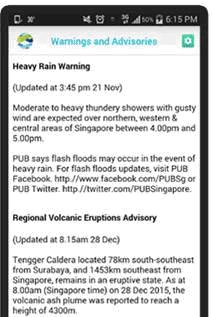
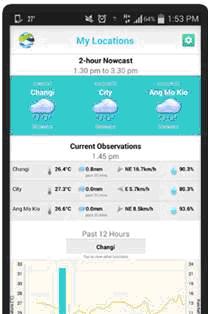
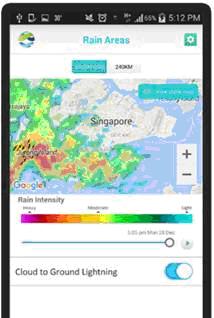
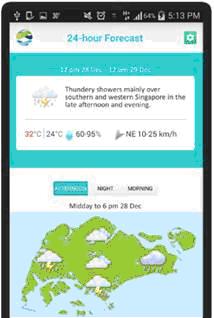
9 The ‘Weather@SG’ mobile application provides users with access to the latest national forecasts, observations as well as warnings and advisories. Through the ‘Weather@SG’ application, mobile phone users can receive push notifications of heavy rain warnings and other hazards. The weather mobile application has features to detect a user’s location and automatically display the 2-hour Nowcast and the current weather conditions such as temperature, rain amount and wind information. In addition, graphical temperature and rainfall trends for the past 12 hours are available. Users will also be able to view the rain areas over the island and up to 240km away. Please refer to Annex B for screenshots of the ‘Weather@SG’ mobile application.
[1] As per media release issued by World Meteorological Organisation (WMO) Media Centre on 25 January 2016 (https://www.wmo.int/media/content/2015-hottest-year-record)
– End –
ANNEX A
Table of Records for the Top 10 Warmest and Driest Years in Singapore
The table below details the top 10 warmest annual mean temperatures as well as top 10 driest years for Singapore. The climatological (1981-2010) average for Singapore is 27.50C for annual mean temperature and 2165.9 mm for annual rainfall.
<tdstyle=”width: 198px;”>27.919711613.5
| Top 10 Warmest Year |
Top 10 Driest Years |
| Year |
Annual Mean Temp (0C) |
Year |
Annual Rainfall (mm) |
| 2015 |
28.3 |
1997 |
1118.9 |
| 1998 |
28.3 |
2015 |
1266.8 |
| 1997 |
28.3 |
1985 |
1483.9 |
| 2010 |
28.1 |
1990 |
1523.8 |
| 2002 |
28.1 |
2014 |
1538.4 |
| 2005 |
28.0 |
1981 |
1555.8 |
| 2014 |
27.9 |
1960 |
1569.6 |
| 2009 |
27.9 |
1888 |
1605.0 |
| 2004 |
| 2003 |
27.8 |
1877 |
1654.0 |
Table 1: Top 10 Warmest and Driest years on record (based on climate station)
ANNEX B
Screen Shots of ‘Weather@SG’ Mobile Application
The screen shots below highglights some of the key feature of the Weather@SG’ Mobile Application.
| Receive warnings of heavy rain and other hazards
|
Get the 2-hour nowcast and latest observations of your current and favourite locations
|
|
Access current rain areas
|
Get the weather forecast for the next 24 hours, and see what’s in store for the next few days
|
[1] As per media release issued by World Meteorological Organisation (WMO) Media Centre on 25 January 2016 (https://www.wmo.int/media/content/2015-hottest-year-record)