Category Archives: News

February 9, 2017

Weather update 9 February 2017

A temporary reprieve from the wet weather that Singapore has been experiencing this past week can be expected for the next few days. This is due to an incursion of drier air over the region, bringing generally fair and occasionally windy conditions to Singapore.

Rainy conditions can be expected again when a monsoon surge* is forecast to affect the South China Sea from around this Sunday (12 February). The surge will bring windy conditions with widespread rain, heavy at times, on some days in the coming week. The daily temperature during this period is expected to range between 22°C and 29°C.

*A monsoon surge refers to a strengthening of winds over the South China Sea, causing extensive rainclouds to form over our surrounding region.

(Issued on 9 Feb 2017)

February 1, 2017

Start of Dry Phase of the Northeast Monsoon

Short-duration thundery showers on some days

Singapore, 1 February 2017  – In the first fortnight of February 2017, the prevailing Northeast Monsoon season is forecast to enter its dry phase, which is characterised by drier weather and occasionally windy conditions. During this period, the low level winds are forecast to blow predominantly from the northeast or northwest.

2          Compared to the second half of January 2017 when Singapore experienced wet weather conditions on most days, the first fortnight of February 2017 is forecast to be drier and warmer. In addition, the daily temperature is expected to range between 23°C and 33°C, and could reach a high of around 34°C on some days.

3          Climatologically, February is the driest month of the year. During the dry phase of the Northeast Monsoon season, the monsoon rain belt typically lies south of the Equator, resulting in fewer rain days[1] for Singapore. For the first fortnight of February 2017, short-duration thundery showers due to strong solar heating of land areas coupled with convergence of winds can still be expected mostly in the afternoon on four or five days. Rainfall for the first half of February 2017 is forecast to be below normal.

4         For updates of the daily weather and haze forecast, please visit our MSS website (https://www.weather.gov.sg), NEA website (www.nea.gov.sg), or download the myENV app, MSS’ Weather@SG app.

[1] A rain day is defined as a day in which rainfall recorded for that day is 0.2mm or more.

Review: 1 – 31 January 2017

5          Northeast Monsoon conditions prevailed over the region in January 2017 with the low level winds blowing predominantly from the northeast and occasionally from the northwest.

6          The region experienced two episodes of monsoon surge[2] in the second half of January 2017. The first monsoon surge on 22-24 January 2017 brought overcast and occasionally windy conditions with periods of widespread moderate to heavy showers to Singapore. Over the Lunar New Year weekend on 28-29 January 2017, the second monsoon surge brought widespread showers mostly over the sea areas south and east of Singapore, while brief light to moderate afternoon showers fell over the island. For most other days in January 2017, Singapore experienced thundery showers in the afternoon. The highest total daily rainfall recorded during the month was 106.0mm around the Kallang area on 23 January 2017.

7          In January 2017, the daily maximum temperatures ranged between 25.9°C and 35.1°C, and the daily minimum temperatures ranged between 21.7°C and 25.4°C. While cooler temperatures were recorded in the second half of the month due to rainy weather, there were some warm days during the month as well. At the Changi climate station, the daily maximum temperature of 33.7°C recorded on 8 January 2017 surpassed the record highest daily maximum temperature for January by 0.1°C set on 27 January 1998. In addition, the mean monthly temperature of 26.9°C for January 2017 is 0.4°C above the long-term mean for January.

8          There were 21 rain days recorded for the month at the Changi climate station, which is significantly higher than the long-term average of 13 rain days for January. Despite the high number of rain days, the monthly rainfall recorded at the climate station in January 2017 was near normal as the rain was less heavy compared to other parts of the island. Most parts of Singapore received above normal rainfall in January 2017. The highest rainfall of 389.4mm (70% above average) was recorded around Paya Lebar area. Rainfall was lowest around Clementi where 177.6mm (18% below average) was recorded.

[2] A monsoon surge refers to a strengthening of winds over the South China Sea, causing extensive rainclouds to form over our surrounding region.


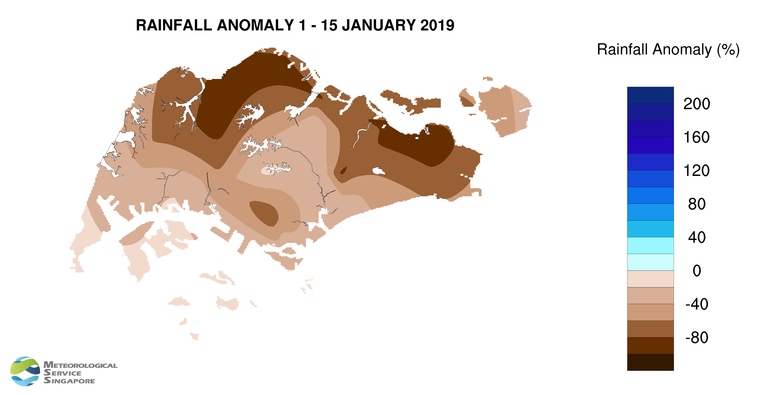
FortnightRain_Anomaly_201701b

CLIMATE STATION STATISTICS FOR FEBRUARY (Climatological reference period: 1981 – 2010)

Mean daily maximum temperature 32.0 °C
Mean daily minimum temperature 24.3 °C
Mean monthly temperature 27.1 °C
Mean rainfall for the month 112.8 mm
Mean number of rain days 8
Highest monthly mean daily maximum temperature 33.5 °C (2010)
Lowest monthlymean daily minimum temperature 23.0 °C (1982)
Highest monthly rainfall 470.4 mm (1984)
Lowest monthly rainfall 6.3 mm (2010)


January 26, 2017

Lunar New Year Weather Forecast

A monsoon surge* is expected to affect the South China Sea and our surrounding region over the next few days. The surge is forecast to bring occasionally windy conditions with passing showers in the afternoon on Friday (27 Jan). Cloudy and occasionally windy conditions with periods of showers, heavy at times, are expected on Saturday (28 Jan), the first day of the Lunar New Year.

The surge is forecast to gradually weaken on Sunday (29 Jan), the second day of the Lunar New Year, and it is expected to be occasionally windy, with passing showers in the afternoon. The daily temperature during the weekend is forecast to range between 22°C and 32°C.

*A monsoon surge refers to a strengthening of winds over the South China Sea, causing extensive rainclouds to form over our surrounding region.

(Issued on 26 Jan 2017)

January 16, 2017

More Showers Expected in Second Fortnight of January 2017

A few warm days can still be expected

Singapore, 16 January 2017  – The prevailing Northeast Monsoon conditions over the region are forecast to persist into the second half of January 2017. During this fortnight, the low level winds are expected to continue to blow from the northeast or northwest.

2          The next two weeks of January 2017 is expected to be wetter than the first fortnight of the year. Short-duration thundery showers are expected on six to eight days, mostly in the afternoon, and on a few days could extend into the evening. In addition, there is a chance of a monsoon surge[1] developing over the southern South China Sea region in the second week of the fortnight. Singapore could experience periods of moderate to heavy rain lasting up to two days, accompanied by occasional windy conditions and cooler temperatures. Overall, the rainfall for January 2017 is forecast to be slightly below normal.

3          In the next fortnight, a few warm days can still be expected. The daily maximum temperatures on most days are forecast to be around 32°C or 33°C, and on a few days, the daily maximum temperatures could reach a high of around 34°C. On some rainy days, the daily minimum temperature is expected to be cooler, and could range between 22°C and 23°C.

4         For updates of the daily weather and haze forecast, please visit our MSS website (https://www.weather.gov.sg), NEA website (www.nea.gov.sg), or download the myENV app, MSS’ Weather@SG app.

Review: 1 – 15 January 2017

5          Northeast Monsoon conditions prevailed over the region in the first fortnight of 2017, and the low level winds during the period blew mostly from the northwest or north.

6          There were a few dry and warm days in the first two weeks of January 2017 where temperatures above 33°C were recorded at some stations. The highest temperature recorded in the first fortnight of January 2017 was 35.1°C at Sembawang on 9 January 2017. At the Changi climate station, the mean daily maximum temperature recorded in the first half of January 2017 was 31.3°C, which is 1.1°C above the long-term mean for January.

7          In the first fortnight of January 2017, Singapore experienced thundery showers in the afternoon and evening on several days due to strong solar heating of land areas coupled with convergence of winds in the surrounding vicinity. In addition, the occurrence of Sumatra squalls brought moderate to heavy thundery showers over many parts of Singapore between the predawn and early morning on a few days. The thundery showers were heaviest on New Year’s Day where the highest total daily rainfall recorded was 71.8mm in Jurong Island.

8          For the first two weeks of the year, Singapore received significantly below normal rainfall. The lowest rainfall of 12.8mm (88% below average) was recorded around the Jurong area, and rainfall was highest around the Paya Lebar area where 98.3mm (11% below average) was recorded.

[1] A monsoon surge is characteristic of the wet phase of the Northeast Monsoon season (Dec – Jan). It is due to the strengthening of northeasterly winds over the South China Sea and our surrounding region, and can bring widespread rain to coastal areas in the Southeast Asia region. Read more at https://www.weather.gov.sg/learn_weather_systems/

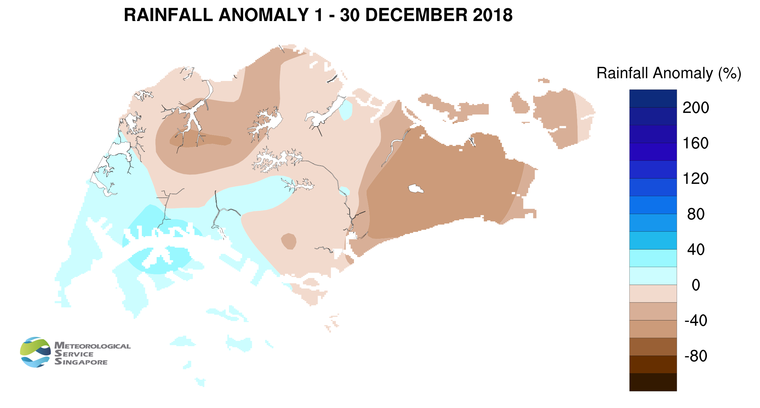
FortnightRain_Anomaly_201701a

CLIMATE STATION STATISTICS FOR JANUARY (Climatological reference period: 1981 – 2010)

Mean daily maximum temperature 30.4 °C
Mean daily minimum temperature 23.9 °C
Mean monthly temperature 26.5 °C
Mean rainfall for the month 234.6 mm
Mean number of rain days 13
Highest monthly mean daily maximum temperature 31.8 °C (1998)
Lowest monthlymean daily minimum temperature 22.6 °C (1981,1982)
Highest monthly rainfall 600.9 mm (2004)
Lowest monthly rainfall 15.4 mm (1997)


December 30, 2016

2016 Set to be Hottest Year on record in Singapore

Expect mostly afternoon thundery showers in the first half of January 2017

Singapore, 30 December 2016  – The current Northeast Monsoon conditions over the region are forecast to prevail into the first fortnight of 2017. During this period, the low level winds are forecast to blow mainly from the northeast or northwest.

2          The first fortnight of 2017 is expected to be less wet compared to the rainy weather in the past two weeks. Thundery showers are still expected mostly in the afternoon on five to seven days, and could extend into the evening on a few days. Widespread thundery showers accompanied by gusty winds can also be expected between the predawn and early morning on one or two days. The rainfall for the first half of January 2017 is forecast to be slightly below normal.

3          During the outlook period, the daily maximum temperature on most days is forecast to be around 32°C or 33°C. Some cooler nights are expected, with the daily minimum temperature ranging between 23°C and 24°C.

4          The year 2016 is set to be the hottest year on record in Singapore since temperature records started in 1929. The mean annual temperature recorded at the Changi climate station (as at 29 December 2016) is 28.4°C, exceeding the current record of 28.3°C set in 1997, 1998 and 2015. Temperatures soared in the first half of 2016 due to the effects of a very strong El Niño. The temperatures remained well above the long-term average for the rest of the year. New monthly records for the hottest January, April and August were set in 2016.

5          The annual total rainfall recorded at the Changi climate station (as at 29 December 2016) is 1954mm. This is higher than the 1267mm rainfall recorded in 2015 (the second lowest on record), and 10% below the long-term annual mean of 2166mm (based on reference period 1981-2010).

6         For updates of the daily weather and haze forecast, please visit our MSS website (https://www.weather.gov.sg), NEA website (www.nea.gov.sg), or download the myENV app, MSS’ Weather@SG app.

Review: 1 – 29 December 2016

7          In December 2016, the region experienced Northeast Monsoon conditions where the low level winds were mostly blowing from the northwest or north.

8          The mean monthly temperature recorded at the Changi climate station (as at 29 December 2016) is 27.4°C, which is 0.3°C lower than the highest ever recorded mean December temperature set in 2015. December 2016 is on track to be the second hottest December on record.

9          Singapore experienced wetter weather conditions in the second half of December 2016 compared to the first half of the month. Most of the thundery showers occurred in the afternoon and evening due to strong solar heating of land areas coupled with convergence of winds in the surrounding vicinity. A high occurrence of Sumatra squalls during the month also brought moderate to heavy thundery showers to many parts of Singapore on several days in the pre-dawn hours and morning. The heaviest rain events occurred on 23 and 24 December 2016, where the highest daily rainfall of 98mm and 86mm was recorded over Bukit Panjang and Tai Seng respectively.

10        Almost all parts of Singapore received below normal rainfall in December 2016. The lowest rainfall of 116.4mm (55% below average) was recorded over the Jurong area. Rainfall was highest around Serangoon where 289.5mm (4% above average) was recorded.

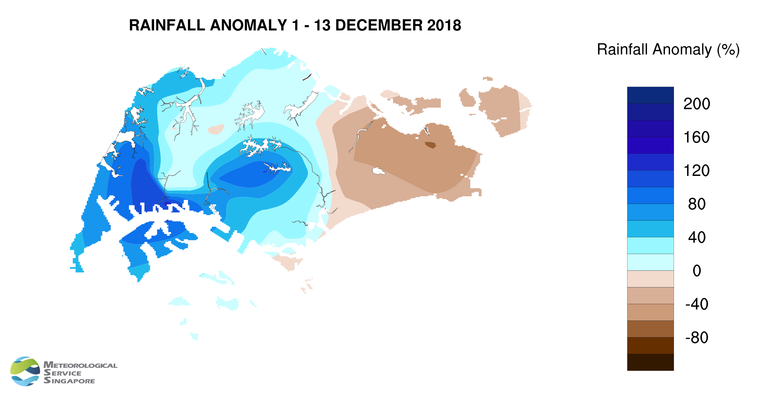
FortnightRain_Anomaly_201612b

CLIMATE STATION STATISTICS FOR JANUARY (Climatological reference period: 1981 – 2010)

Mean daily maximum temperature 30.4 °C
Mean daily minimum temperature 23.9 °C
Mean monthly temperature 26.5 °C
Mean rainfall for the month 234.6 mm
Mean number of rain days 13
Highest monthly mean daily maximum temperature 31.8 °C (1998)
Lowest monthlymean daily minimum temperature 22.6 °C (1981,1982)
Highest monthly rainfall 600.9 mm (2004)
Lowest monthly rainfall 15.4 mm (1997)


December 16, 2016

Wetter Weather Expected in the Next Fortnight

Significantly below normal rainfall in first half of Dec 2016

Singapore, 16 December 2016 – Northeast Monsoon conditions are forecast to continue to prevail in the last fortnight of 2016. The low level winds during this period are forecast to blow mostly from the northwest or northeast. In addition, short-duration thundery showers, at times heavy, can be expected on seven to nine days, mostly between the late morning and afternoon.

2          On one or two days in the next fortnight, the presence of low pressure systems over the surrounding sea areas are expected to bring a shift in the low level winds to blow from the southwest or west. This could lead to the development of Sumatra squalls over the Strait of Malacca and bring widespread thundery showers accompanied by gusty winds to Singapore between the predawn and morning. The second half of December 2016 is expected to be wetter than the first fortnight of December 2016. Overall, the rainfall for December 2016 is forecast to be below normal.

3          Although December is one of the cooler months of the year, a few warm days can still be expected. In the next fortnight, the daily maximum temperatures on most days are forecast to be around 32°C or 33°C, and on a few days, the daily maximum temperature could reach a high of 34°C. On some rainy days, the daily minimum temperature could range between 22°C and 24°C.

4         For updates of the daily weather and haze forecast, please visit our MSS website (https://www.weather.gov.sg), NEA website (www.nea.gov.sg), the haze microsite (www.haze.gov.sg) or download the myENV app, MSS’ Weather@SG app.

Review: 1 – 15 December 2016

5          Northeast Monsoon conditions prevailed over the region in the first fortnight of December 2016. While the low level winds blew from the northwest on most days, there were some days when the winds were from the southwest or west due to the influence of Tropical Cyclones “Vardah” and “Nada” over the Bay of Bengal.

6          There were a few warm days in the first two weeks of December 2016 where the daily maximum temperature was between 34°C and 35°C. At the Changi climate station, the mean daily maximum temperature recorded in the first half of December 2016 was 31.8°C, which is 1.6°C above the long-term mean for December. In addition, the mean monthly temperature recorded was 27.8°C, which is 1.4°C warmer than the long-term mean for December.

7          In the first fortnight of December 2016, most of the thundery showers over the island occurred between midnight and 6am. These were due to Sumatra squalls moving across the island, coupled with strong convergence of winds in the surrounding vicinity. In addition, there were a few days of moderate to heavy rainfall over Singapore between the late afternoon and evening due to strong solar heating of land areas. During the period, the heaviest daily rainfall of 45.4mm was recorded on 1 December 2016 around Tuas.

8          For the period from 1 to 15 December 2016, rainfall across Singapore was significantly below normal. The highest rainfall of 128mm (18% below average) was recorded around Changi. Rainfall was lowest around Jurong where 25.2mm (81% below average) was recorded.

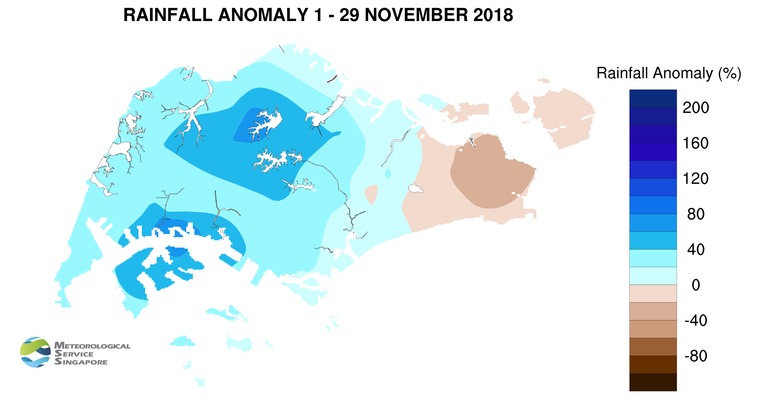
FortnightRain_Anomaly_201612a

CLIMATE STATION STATISTICS FOR DECEMBER (Climatological reference period: 1981 – 2010)

Mean daily maximum temperature 30.2 °C
Mean daily minimum temperature 24.0 °C
Mean monthly temperature 26.4 °C
Mean rainfall for the month 318.6 mm
Mean number of rain days 18
Highest monthly mean daily maximum temperature 31.3 °C (1997, 2002)
Lowest monthlymean daily minimum temperature 23.0 °C (1981,1983)
Highest monthly rainfall 765.9 mm (2006)
Lowest monthly rainfall 62.9 mm (1988)


December 1, 2016

Northeast Monsoon Conditions to Prevail in December 2016

Expect cool nights on a few days

Singapore, 1 December 2016 – In late November 2016, the low level winds that were light and variable in direction gradually strengthened and shifted to blow from the northeast or northwest. This signalled the start of the Northeast Monsoon season in the region which typically extends from December to March.

2      In the first fortnight of December 2016, the prevailing low level winds are forecast to blow predominantly from the northeast or northwest. With the expected presence of low pressure systems such as tropical storms in the region, the low level winds could shift to blow from the west or southwest on some days.

3      For the next two weeks, short-duration thundery showers, at times heavy, are expected in the afternoon and evening on five to six days. In addition, widespread thundery showers accompanied by gusty winds due to the occurrence of Sumatra squalls can be expected between the predawn and morning on one or two days. The rainfall for the first two weeks of December 2016 is forecast to be below normal.

4      During the outlook period, daily maximum temperatures of between 32°C and 33°C are expected on most days. On a few rainy days, the daily maximum temperature could reach a high of around 30°C, and the daily minimum temperature, in particular during the night, is expected to be cool and range between 22°C and 24°C.

5      For updates of the daily weather and haze forecast, please visit our MSS website (https://www.weather.gov.sg), NEA website (www.nea.gov.sg), the haze microsite (www.haze.gov.sg) or download the myENV app, MSS’ Weather@SG app.

Review: 1 – 30 November 2016

6      Inter-Monsoon conditions prevailed over Singapore and the surrounding region for most parts of November 2016 before the onset of the Northeast Monsoon season in late November 2016. The low level winds during the period were predominantly light and variable in direction.

7      Despite the wet weather conditions experienced in November 2016, there were some warm days where the highest daily maximum temperature recorded was between 33.6°C and 34.4°C. At the Changi climate station, the mean monthly temperature for November 2016 was 27.4°C, 0.4°C warmer than the long-term mean for November.

8      In November 2016, the thundery showers occurred mostly in the afternoon due to strong solar heating of land areas coupled with the convergence of winds over Singapore and the surrounding vicinity. On several days during the month, the occurrence of Sumatra squalls brought moderate to heavy thundery showers to many parts of Singapore in the pre-dawn hours and morning. The heaviest daily rainfall of 128mm was recorded on 14 November 2016 over Semakau Island while for the mainland Singapore, the highest rainfall recorded was 78.2mm over the Jurong area on 16 November 2016.

9      About half of Singapore received above normal rainfall in November 2016. The highest rainfall of 413.2mm (53% above average) was recorded around Paya Lebar area. Rainfall was lowest around Admiralty where 160.6mm (36% below average) was recorded.

FortnightRain_Anomaly_201611b

CLIMATE STATION STATISTICS FOR DECEMBER (Climatological reference period: 1981 – 2010)

Mean daily maximum temperature 30.2 °C
Mean daily minimum temperature 24.0 °C
Mean monthly temperature 26.4 °C
Mean rainfall for the month 318.6 mm
Mean number of rain days 18
Highest monthly mean daily maximum temperature 31.3 °C (1997, 2002)
Lowest monthlymean daily minimum temperature 23.0 °C (1981,1983)
Highest monthly rainfall 765.9 mm (2006)
Lowest monthly rainfall 62.9 mm (1988)


November 24, 2016

Onset of Northeast Monsoon Season in Late November

JOINT ADVISORY BETWEEN PUB AND NEA

Singapore, 24 November 2016 – The Meteorological Service Singapore (MSS), forecasts that the Northeast Monsoon season is expected to onset in late November 2016. This is the traditional rainy season in the southern ASEAN region, and comprises two phases, a wet phase (December – January) and a dry phase (February – March).

2          The wet phase is characterised by short-duration moderate to heavy thundery showers mostly in the afternoon and on some days, extending into the evening. There is an average[1] of 18 rain days in December, and 13 rain days in January. The wet phase also experiences about two to four episodes of monsoon surges[2]. In contrast, the dry phase (February – March), typically brings less rainfall, drier weather conditions and occasional windy conditions compared to the December – January period.

3          During the Northeast Monsoon season, in addition to the regular weather forecast and warnings, MSS will issue prolonged monsoon heavy rain warnings when intense rain or prolonged monsoon rain is expected. This will help members of the public better prepare for periods of heavy rain.

4          In December 2016 and January 2017, high tides of at least 3.2m are expected on some days (see Table 1 below). Heavy rain coinciding with high tides could lead to localised flash floods in the low-lying areas.

tide table

Table 1 – High Tides of at least 3.2m are expected on some days in December 2016 and January 2017

—————————————————–

[1] Based on 30-yr climatological reference period (1981- 2010)

[2] Monsoon surge refers to the steady strengthening of northeasterly winds blowing from the South China Sea, and usually bring periods of prolonged, widespread, moderate to heavy rain lasting between two and five days, occasional windy conditions, and cooler temperatures to Singapore and the surrounding vicinity

Preparing for the Northeast Monsoon

5          Officers from PUB, Singapore’s National Water Agency has distributed flood advisories to around 600 residents and shop-owners in low-lying and hotspot areas, some of which are subject to tidal influence. The advisory provides tips they could take to protect their belongings and premises against possible flash floods.

6          In addition to reminding the construction industry to conduct checks on the public drains in the vicinity of their respective construction sites, PUB has inspected about 100 major construction worksites to ensure that the drains around the construction sites are free-flowing.

7          PUB has been working closely with agencies and Town Councils, to ensure that the drains and canals island-wide are clean and functioning effectively to prepare for the wet weather ahead. For example, the National Environment Agency (NEA) has increased the frequency of their checks and cleaning of drains and Drop-Inlet Chambers.

Improving Our Drainage System

 8          Since 2012, PUB has adopted a holistic “Source-Pathway-Receptor” approach, which looks at catchment-wide solutions to enhance flood protection. As part of continual drainage improvement, PUB carries out upgrading of the “pathways”, through which stormwater travels.

9          Since 2013, PUB has completed drainage improvement projects at 273 locations. This year, PUB completed improvement projects at another 36 locations. These include drainage works at East Coast and Somerset Road.

10        Drainage improvement projects are currently on-going at 76 locations across Singapore. Drainage improvement works to Sunset Way outlet drain are expected to be completed in the second quarter of 2017 while works at Kallang River (between Bishan Road to Braddell Road) are expected to be completed by the fourth quarter of 2018.

Monitoring Floods Online

11        As part of flood monitoring efforts, PUB has a network of 170 closed circuit television (CCTV) cameras to monitor real-time road conditions in low-lying areas and hotspots. Members of the public can view 49 of these CCTV images which are refreshed every five minutes.

12        PUB has 205 water level sensors installed in the island’s major drains and canals, which provide real-time data on water levels, and serve to enhance PUB’s live monitoring of site conditions during heavy storms and enable quick response. Information from all water level sensors is also available to the members of the public.

 Keeping Members of the Public Informed

13        To obtain the latest weather reports, including heavy rain warnings, members of the public can tune in to radio traffic watch broadcasts, call MSS’ weather forecast hotline at 65427788, visit the MSS website at https://www.weather.gov.sg and access NEA’s mobile app MyENV, MSS’ mobile app Weather@SG or subscribe to the heavy rain warning SMS alert service provided by the MSS.

14        During heavy rain events, the public can also be updated on rising water levels in drains or canals and flash floods via PUB’s Facebook and Twitter, PUB’s free mobile app MyWaters, and PUB’s website.

15        Members of the public can also subscribe to a free SMS alert service to keep tabs on the water level in a canal or drain at a designated location via PUB’s website – https://www.pub.gov.sg/drainage/floodmanagement/subscribesms

16        In addition, selected CCTV images of road conditions in low-lying areas and hotspots can be accessed via PUB’s website or MyWaters mobile app.

17        Members of the public are advised to exercise caution during the monsoon season should flash floods occur in the event of heavy storms. Motorists should avoid driving into flooded areas, as low visibility can obscure the depth of floodwaters. Pedestrians caught in a flash flood are advised to move to higher ground and refrain from walking through flood waters.

18        Members of the public can call PUB’s 24-hour Call Centre at 1800-CALL PUB (1800-2255 782) to report on any flood situation or NEA’s hotline at 1800-6003333 to report on any choked drains.

– End –

November 16, 2016

Wet Weather to Persist in the Next Fortnight

Onset of Northeast Monsoon expected in end November 2016

Singapore, 16 November 2016 – The prevailing inter-monsoon conditions are expected to persist over Singapore and the surrounding region in the second fortnight of November 2016. Light and variable low level winds are forecast for most days in the fortnight. The winds are expected to gradually strengthen and blow from the northeast or northwest around the end of the month, signalling the onset of the Northeast Monsoon.

2          For the rest of November 2016, the wet weather experienced in the first fortnight of the month are expected to persist. Thundery showers, heavy at times, are forecast mostly in the afternoon and evening on six to eight days. In addition, widespread thundery showers accompanied by gusty winds can be expected between the predawn and early morning on one or two days during the period. Based on long-term statistics, November is the second wettest month in the year after December. The rainfall for November 2016 is forecast to be above normal.

3          For the rest of the month, the daily maximum temperature on most days is forecast to be around 32°C or 33°C. On rainy days, cooler nights are expected with the daily minimum temperature ranging between 22°C and 23°C.

4        For updates of the daily weather and haze forecast, please visit our MSS website (https://www.weather.gov.sg), NEA website (www.nea.gov.sg), the haze microsite (www.haze.gov.sg) or download the myENV app, MSS’ Weather@SG app.

Review: 1 – 15 November 2016

5          In the first fortnight of November 2016, Singapore and the surrounding region experienced inter-monsoon conditions, and the low level winds were generally light and variable in direction.

6          Some cool days were experienced during the first two weeks of the month due to rainy conditions. On rainy days, the lowest daily minimum temperature recorded ranged between 21.9°C and 22.8°C. The highest daily maximum temperature recorded during the review period was between 33.2°C and 34.4°C. At the Changi climate station, the mean daily maximum temperature recorded in the first half of November 2016 was 30.7°C, which is 0.4°C below the long-term mean for November.

7          In the first week of November 2016, the eastward passage of Sumatra squalls from the Strait of Malacca brought widespread moderate to heavy thundery showers over Singapore in the pre-dawn hours and early morning on several days. With the weakening of winds in the second week of the month, moderate to heavy thundery showers fell mostly in the afternoon and evening. The showers were heaviest on 14 November 2016, where the highest daily total rainfall recorded was 128mm over Semakau Island. Over mainland Singapore, the highest daily total rainfall recorded was 78mm over the Ulu Pandan area on 1 November 2016.

8          Most parts of Singapore received above average rainfall during the first fortnight of November 2016. The highest rainfall of 258.4mm (84% above average) was recorded around the Clementi area. Rainfall was lowest around Jurong West where 93.6mm (27% below average) was recorded.

FortnightRain_Anomaly_201611a

CLIMATE STATION STATISTICS FOR NOVEMBER (Climatological reference period: 1981 – 2010)

Mean daily maximum temperature 31.1 °C
Mean daily minimum temperature 24.3 °C
Mean monthly temperature 27.0 °C
Mean rainfall for the month 258.5 mm
Mean number of rain days 18
Highest monthly mean daily maximum temperature 32.0 °C (1997)
Lowest monthlymean daily minimum temperature 23.6 °C (1981,1983,1991)
Highest monthly rainfall 508.4 mm (1989)
Lowest monthly rainfall 53.5 mm (1981)


November 1, 2016

Inter-monsoon Conditions to Prevail in November 2016

Expect more thundery showers in the next fortnight

Singapore, 1 November 2016 – Singapore and the surrounding region are currently experiencing Inter-monsoon conditions which are expected to prevail during the first fortnight of November 2016. The Inter-monsoon period is characterised by an increase in the occurrence of showers, heavy at times, over Singapore, and winds that are mostly light and variable in direction.

2          For the first half of November 2016, short-duration thundery showers are expected on five or six days, mostly in the afternoon and could extend into the evening. In addition, widespread thundery showers accompanied by gusty winds are expected on three or four days between the predawn and early morning. November is climatologically the second wettest month of the year after December. In the first fortnight of November 2016, rainfall is expected to be slightly above normal.

3         In the coming fortnight, the maximum daily temperature on most days is forecast to be around 32°C or 33°C, and on a few days could reach a high of around 34°C.

4        For updates of the daily weather and haze forecast, please visit our MSS website (https://www.weather.gov.sg), NEA website (www.nea.gov.sg), the haze microsite (www.haze.gov.sg) or download the myENV app, MSS’ Weather@SG app.

Review: 1 – 31 October 2016

5          Southwest Monsoon conditions prevailed in the region for most parts of October 2016, before transitioning to Inter-monsoon conditions in the last week of the month. In October 2016, the low level winds were mostly blowing from the southwest or west.

6          Compared with the first half of October 2016, Singapore experienced fewer warm days in the second half of the month due to more frequent rain showers in the region. The daily maximum temperature for October 2016 ranged between 29.3°C and 34.6°C. At the Changi climate station, the mean monthly temperature recorded for October 2016 was 28.4°C, which is 0.8°C warmer than the long-term mean for October.

7          In October 2016, thundery showers occurred mostly in the late morning and afternoon due to strong solar heating of land areas coupled with the convergence of winds over Singapore and the surrounding vicinity. On several days during the period, the occurrence of Sumatra squalls brought moderate to heavy thundery showers to many parts of Singapore in the pre-dawn hours and early morning. The heaviest daily rainfall of 96.8mm was recorded on 3 October 2016 around Buona Vista.

8         Most parts of Singapore received above normal rainfall in October 2016. The highest rainfall of 328mm (46% above average) was recorded around Boon Lay area. Rainfall was lowest around Upper Thomson where 188.8mm (11% below average) was recorded.

FortnightRain_Anomaly_201610b

CLIMATE STATION STATISTICS FOR NOVEMBER (Climatological reference period: 1981 – 2010)

Mean daily maximum temperature 31.1 °C
Mean daily minimum temperature 24.3 °C
Mean monthly temperature 27.0 °C
Mean rainfall for the month 258.5 mm
Mean number of rain days 18
Highest monthly mean daily maximum temperature 32.0 °C (1997)
Lowest monthlymean daily minimum temperature 23.6 °C (1981,1983,1991)
Highest monthly rainfall 508.4 mm (1989)
Lowest monthly rainfall 53.5 mm (1981)